
SQL Mistakes That Can Lead to Inaccurate Data Analysis
SQL is an essential tool for data analysts because it helps them extract, organize, filter, and interpret information stored in databases. Accurate queries allow businesses to understand performance, discover patterns, and make informed decisions. However, even minor errors in SQL statements can affect the final output and lead to incorrect conclusions. Common problems include incorrect filtering conditions, unsuitable joins, improper use of aggregate functions, duplicate records, and mishandling missing values. By understanding these challenges and learning how to prevent them, analysts can improve the reliability of their reports and develop stronger data analysis skills.
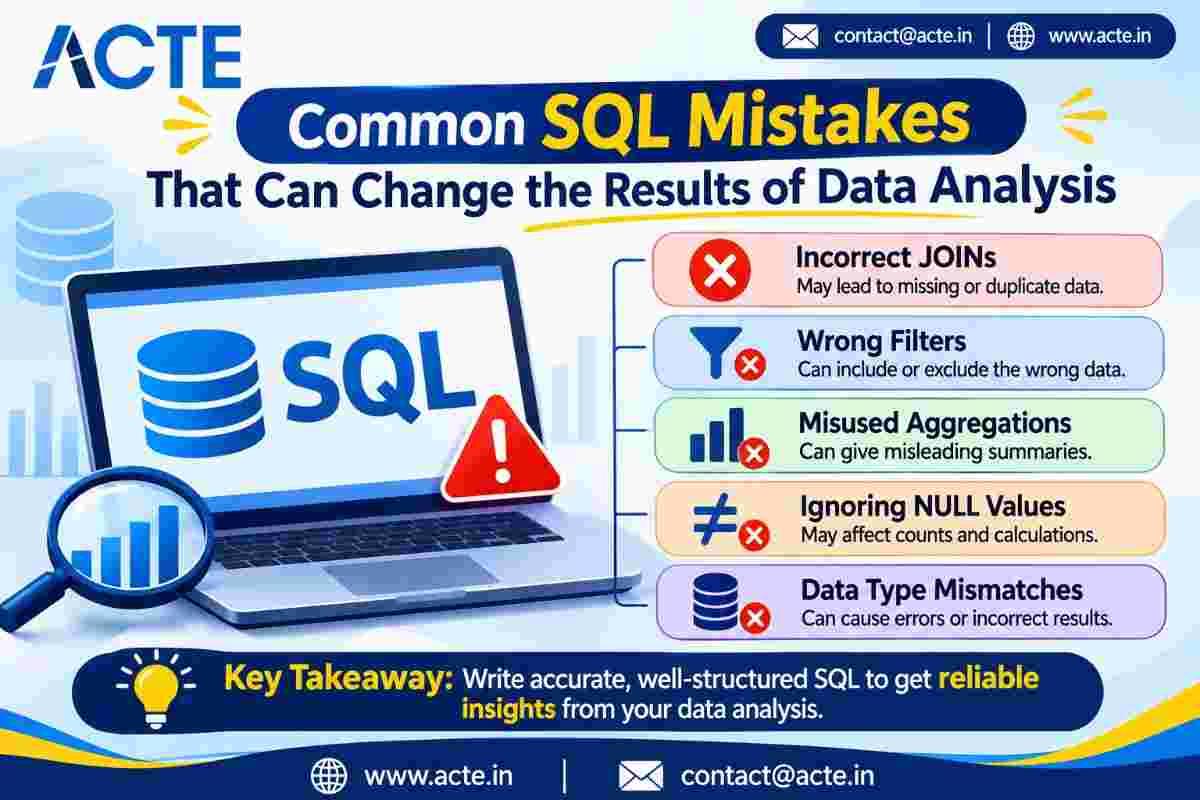
1. Applying Incorrect Filtering Conditions
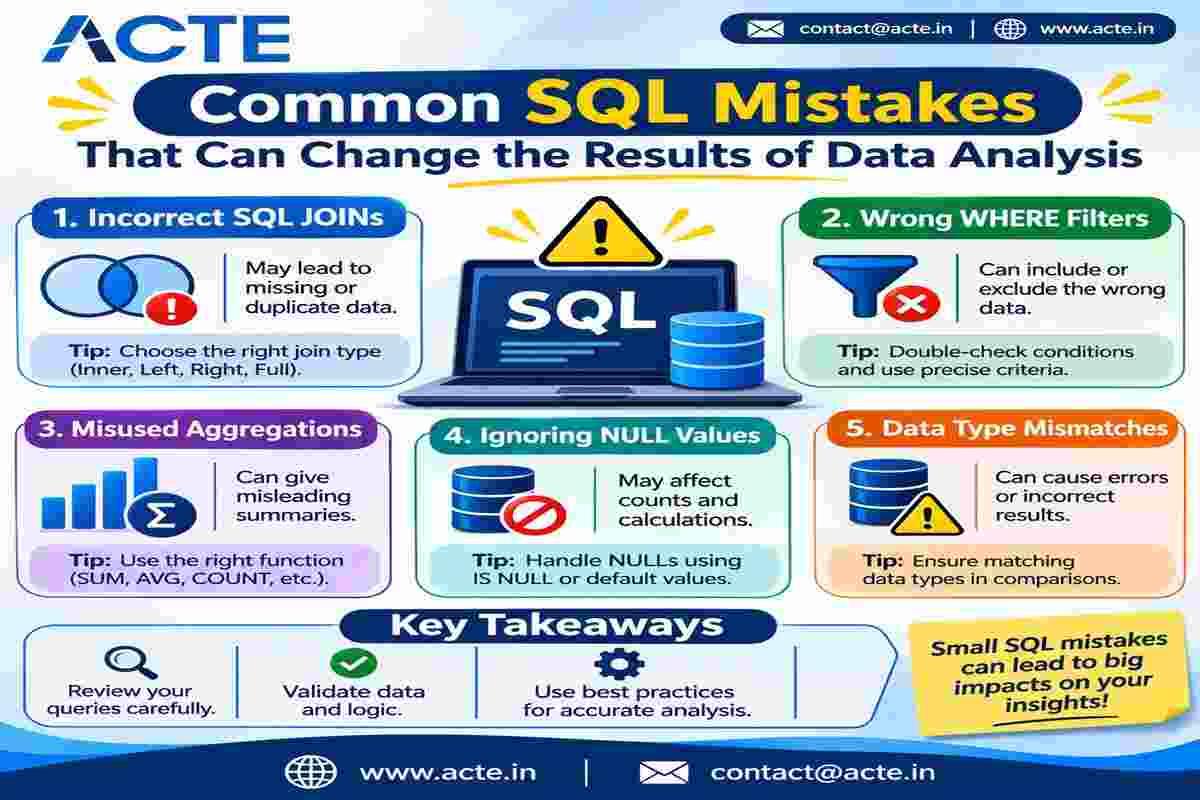
The WHERE clause helps analysts retrieve records that match specific requirements. When conditions are written incorrectly, important information may be excluded or unrelated records may appear in the output. For example, selecting an incorrect sales period or using the wrong product category can change the final figures. Combining multiple conditions with AND and OR can also produce unexpected results if parentheses are not used appropriately. Analysts should review filtering logic carefully, test queries with sample records, and compare the output with expected results. Learning these techniques through a Data Analytics Training Course can help learners understand how SQL conditions influence analysis.
2. Selecting an Unsuitable JOIN Operation
JOIN operations allow analysts to combine information from related database tables. Choosing the wrong join type can remove required records or increase the number of rows unexpectedly. An INNER JOIN returns rows with matching values in both tables, whereas a LEFT JOIN preserves every row from the left table, including those without a matching record on the right. For example, using an inner join when a report must include every customer could exclude customers who have not placed an order. Before selecting a join, analysts should understand the relationship between tables, check the join keys, and verify the resulting row count. These steps help prevent missing information and inaccurate summaries.
3. Calculating Results Incorrectly with Aggregate Functions
SQL aggregate functions such as SUM(), AVG(), COUNT(), MIN(), and MAX() are widely used to summarize datasets. However, using the wrong function or applying it to an unsuitable column can produce misleading metrics. For example, counting transactions instead of unique customers may exaggerate customer totals. COUNT(*) counts rows, while COUNT(column_name) counts non-NULL values in a particular column. Similarly, COUNT(DISTINCT customer_id) counts unique, non-NULL customer identifiers. Analysts should choose calculations that match the question being investigated and verify the results before including them in reports. A strong understanding of these functions is valuable for learners pursuing a Data Analytics Course in Chennai.
4. Overlooking Duplicate Data
Duplicate records can cause incorrect totals, inflated transaction counts, and unreliable averages. They may appear because of repeated imports, inconsistencies in source systems, or joins that match multiple records. Although the DISTINCT keyword removes duplicate rows from a query result, using it without investigation may hide legitimate records that happen to contain identical values. Analysts should identify the source of duplication and determine whether records are genuinely repeated. Checking primary keys, reviewing unique identifiers, and comparing row counts before and after joins are useful ways to detect these issues. Maintaining appropriate data quality checks helps ensure that the analysis represents the underlying information accurately.
5. Handling NULL Values Incorrectly
A NULL value indicates missing or unknown information in a database. It is different from zero, an empty string, or a regular value. Therefore, analysts should use IS NULL or IS NOT NULL to identify missing values instead of comparing a column with = NULL. Missing values can also influence calculations because many aggregate functions ignore NULL entries. For example, an average based on recorded employee salaries may not represent employees whose salary information is missing. Analysts should investigate why values are absent and decide how to handle them according to the analysis objective. Depending on the situation, the appropriate approach may involve excluding records, investigating the source, or applying a justified replacement method.
6. Making Errors in GROUP BY and HAVING Clauses
The GROUP BY clause organizes records into categories so aggregate functions can calculate summaries for each group. Selecting inappropriate grouping columns can change the level of detail and affect the interpretation of results. For example, grouping sales only by region produces regional totals, while grouping by region and product provides a more detailed breakdown. The WHERE clause filters individual rows before grouping, whereas HAVING filters groups after aggregation. Confusing their purposes can result in incorrect summaries or missing categories. Analysts should choose grouping columns based on the business requirement and examine a sample of the output to confirm that each group represents the intended information.
7. Making Mistakes with Dates and Result Ordering
Date filters are important when analysing sales performance, customer activity, monthly revenue, or operational trends. Incorrect date formats and poorly defined time ranges can exclude records that should be included. For example, a timestamp condition ending at midnight at the beginning of a day may leave out transactions that occur later that day. Analysts should understand the database's date and time formats and define boundaries carefully. They should also avoid assuming that SQL automatically returns rows in a particular order. Using ORDER BY makes the intended sorting explicit. Learners can develop practical query-writing skills through Data Analytics Training in Bangalore.
8. Conclusion:
SQL accuracy is essential for producing trustworthy data analysis results. Incorrect filtering conditions, unsuitable joins, faulty aggregate calculations, duplicate records, missing values, grouping errors, and date-filter problems can all affect the conclusions drawn from a dataset. Analysts can reduce these risks by understanding SQL operations, checking table relationships, validating calculations, and reviewing query results before using them in reports. Regular practice with realistic datasets also helps identify errors and improve problem-solving abilities. Building a careful and systematic approach to SQL enables data analysts to generate reliable insights and support better business decisions.

 English
 Arabic
 French
 Portuguese
 Deutsch
 Turkish
 Dutch
 Italiano
 Russian
 Romaian
 Portuguese (Brazil)
 Greek