
How Can Customized Corporate Applications Help Jeddah Businesses Make Faster Decisions Using Real-Time operational information?
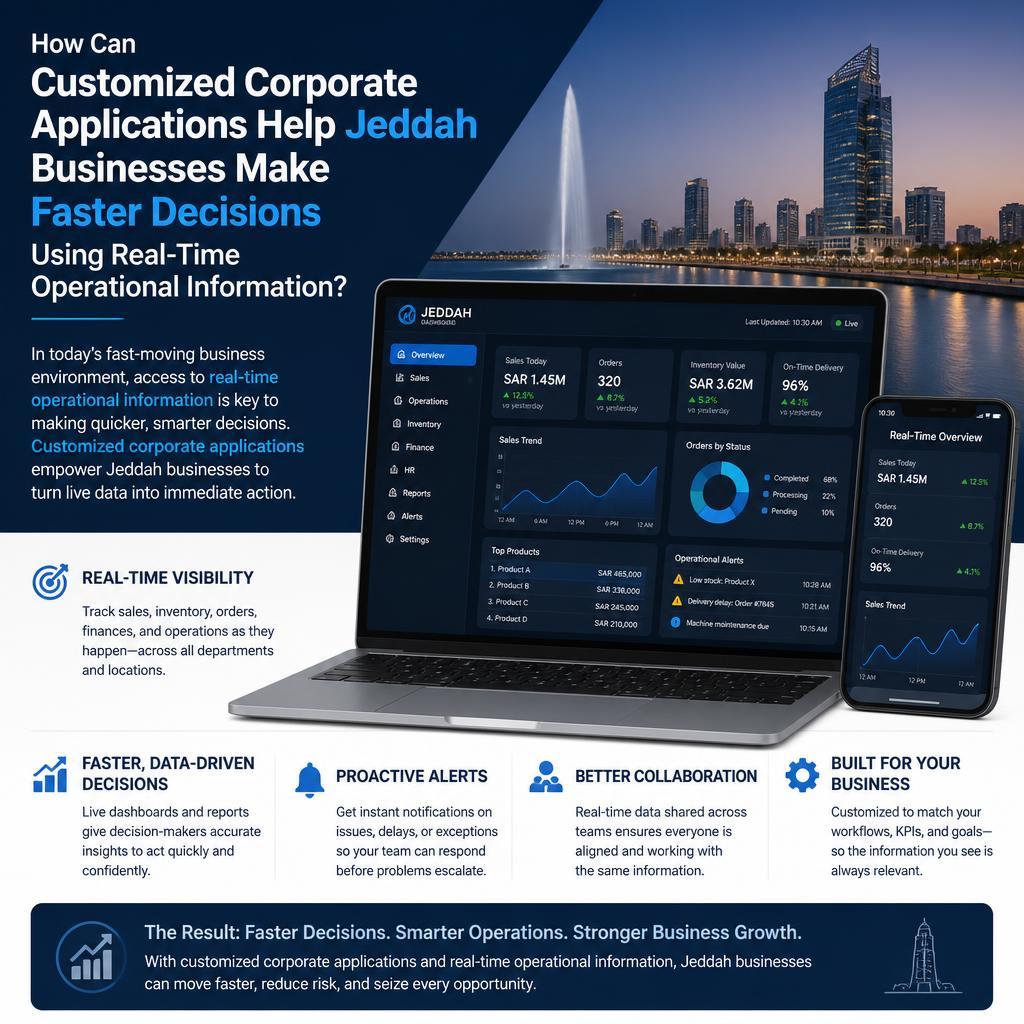
Business decisions are only as effective as the information behind them. When managers depend on outdated spreadsheets, delayed reports, disconnected databases, or repeated phone calls, even experienced teams can struggle to respond quickly to changing circumstances.
For organizations operating in Jeddah, customized corporate applications can provide a more connected approach. By bringing relevant operational information into a centralized mobile environment, businesses can give authorized decision-makers faster access to the information they need.
A purpose-built corporate mobile application is not simply a convenient interface. When properly integrated with business systems, it can become a practical channel for accessing operational data, monitoring activities, receiving alerts, and responding to emerging situations.
For companies in Jeddah, Saudi Arabia, this can support faster decisions across departments while reducing dependence on manual information gathering.
What Is Real-Time Operational Information?
Real-time operational information refers to business data that becomes available quickly after an activity occurs.
Examples might include:
- Current inventory levels
- Order status
- Sales activity
- Employee assignments
- Customer requests
- Delivery progress
- Service tickets
- Production updates
- Appointment schedules
- Financial transactions
The exact information depends on the organization.
For example, a logistics company may need to know whether a delivery has been completed, while a retailer may need visibility into product availability. A service business may want to know which technician is handling a customer request.
The purpose of real-time business information is to reduce the gap between an event happening and management becoming aware of it.
Why Do Traditional Reporting Processes Slow Decisions?
Many businesses still rely on manually compiled reports.
An employee may collect information from several systems, organize it into a spreadsheet, send it to a manager, and wait for the manager to review it. By the time the information reaches the decision-maker, circumstances may have changed.
This can create several problems:
- Decisions based on outdated information
- Delayed responses to customer issues
- Limited visibility across departments
- Duplicate data entry
- Increased administrative effort
- Difficulty identifying operational bottlenecks
For established businesses in Jeddah, these limitations can become more noticeable as operations grow.
A custom enterprise mobile application can shorten this information journey by presenting relevant data through a centralized and accessible interface.
How Customized Corporate Apps Improve Decision-Making
The biggest advantage of customization is that the application can be designed around the organization's actual decision-making requirements.
Instead of presenting every possible piece of information, the application can highlight the metrics and events that matter to specific users.
A regional manager, for instance, might need branch-level performance indicators. A warehouse supervisor may require inventory alerts, while a field-service manager could prioritize outstanding assignments.
This creates a more focused experience.
Centralized Information
A customized application can bring information from multiple business systems into one interface.
This may include CRM, ERP, inventory, accounting, logistics, HR, or customer-service data.
When the relevant information is connected, managers do not have to move between numerous systems to understand a particular situation.
Instant Notifications
Not every event requires someone to continuously monitor a dashboard.
Mobile notifications can alert authorized users when predefined conditions occur.
For example:
- An important order is delayed
- Inventory falls below a threshold
- A customer request remains unresolved
- A field assignment changes
- An approval requires attention
The objective is not to send constant alerts. Notifications should be selective and meaningful.
How Different Industries Can Benefit
Customized corporate applications can support decision-making across many sectors in Jeddah.
Retail Businesses
Retail managers can monitor product availability, sales activity, customer interactions, promotions, and branch performance.
If inventory for a popular item falls below a defined level, responsible employees can receive an alert and take appropriate action.
Logistics Companies
Logistics teams can monitor shipment progress, driver activity, delivery status, and operational exceptions.
A mobile platform can provide managers with a clearer picture of active operations without requiring repeated calls to drivers or dispatch teams.
Manufacturing Organizations
Manufacturers can use mobile applications to access production information, inspection results, maintenance updates, inventory conditions, and operational reports.
This can help supervisors respond more quickly when production issues arise.
Healthcare Providers
Healthcare organizations may use customized applications to coordinate appointments, staff schedules, service requests, operational activities, and authorized administrative information.
Professional Service Companies
Service organizations can monitor job assignments, employee availability, customer requests, appointment schedules, and completion status through a unified platform.
These examples demonstrate why custom mobile app development in Jeddah can be valuable across different business environments.
Integration Is the Key to Real-Time Visibility
A mobile application cannot provide meaningful real-time information if it remains disconnected from the systems generating that information.
Integration should therefore be part of the application strategy from the beginning.
A corporate application may connect with:
- ERP systems
- CRM platforms
- Inventory databases
- Payment systems
- Accounting software
- HR platforms
- Logistics systems
- Customer-support tools
- Business intelligence platforms
APIs can enable controlled data exchange between these systems.
For businesses in Jeddah, effective integration can create a more connected operational environment in which information moves between systems without requiring employees to manually transfer it.
Dashboards Can Turn Data Into Action
Raw information is not automatically useful.
A manager looking at hundreds of individual transactions may struggle to understand what requires attention.
A well-designed dashboard can organize information into meaningful indicators.
Depending on the business, a dashboard could show:
- Current sales
- Open customer requests
- Pending approvals
- Inventory alerts
- Active deliveries
- Employee productivity
- Service completion rates
- Revenue indicators
Visual hierarchy is important. Critical information should be easy to find, while secondary details can remain available when needed.
This is where good enterprise application development combines technology with thoughtful user experience.
Role-Based Information Improves Focus
Different employees should not necessarily see the same information.
A customized corporate application can use role-based permissions to determine which dashboards, records, reports, and actions are available to each user.
For example:
Executive: High-level performance indicators and strategic summaries.
Manager: Departmental performance, exceptions, and approvals.
Supervisor: Team assignments and operational status.
Field Employee: Assigned tasks, customer information, and required reporting tools.
This structure can make the application easier to use while supporting appropriate access controls.
How Automation Can Accelerate Responses
Real-time visibility becomes even more useful when combined with workflow automation.
Consider a customer-support process:
- A customer submits a request.
- The application records the request.
- The appropriate department receives an alert.
- The request is assigned to an employee.
- The employee updates progress.
- The manager can monitor unresolved cases.
- The customer receives status information.
Without automation, several of these steps might require manual communication.
For organizations across Jeddah, automated workflows can reduce administrative delays and make operational responsibilities clearer.
Can AI Make Corporate Applications More Intelligent?
Artificial intelligence can complement real-time operational systems when there is a clear use case.
AI can potentially help organizations:
- Identify unusual patterns
- Summarize operational information
- Prioritize customer requests
- Predict demand
- Recommend actions
- Improve internal search
- Assist customer support
- Analyze large datasets
For example, instead of presenting a manager with a long operational report, an intelligent system could summarize the most significant changes and highlight areas that require attention.
However, AI should support human decision-making rather than replace appropriate business judgment.
Security Should Never Be Sacrificed for Speed
Fast access to information is valuable, but enterprise data must remain protected.
A secure corporate mobile application should consider:
- Authentication
- Authorization
- Role-based access
- Data encryption
- Secure APIs
- Session management
- Audit trails
- Device security
- Backup procedures
- Regular security testing
For businesses in Jeddah, Saudi Arabia, the application's security strategy should also account for applicable local requirements and the sensitivity of the information being handled.
Building an Application That Can Grow
Business requirements rarely stay fixed.
An organization might initially require dashboards and approvals, then later introduce predictive analytics, additional departments, new integrations, or operations across other Saudi cities.
A scalable architecture can make these developments easier to manage.
Businesses should therefore consider:
- Modular application design
- Scalable databases
- Flexible APIs
- Cloud infrastructure
- Expandable user management
- Monitoring and analytics
- Ongoing maintenance
This prevents the application from becoming a technological limitation as the company grows.
Choosing the Right Development Partner
The quality of the development partner can influence everything from application performance to future maintainability.
A capable Mobile App Development Company in Jeddah should understand business workflows as well as mobile technology.
When evaluating potential partners, organizations should ask about:
- Previous enterprise projects
- API integration experience
- Security practices
- Application architecture
- Cloud deployment
- Testing processes
- Scalability planning
- Analytics implementation
- Post-launch maintenance
Businesses searching for the best mobile app company in Jeddah should evaluate technical capabilities, communication, industry understanding, and long-term support rather than relying only on rankings or promotional claims.
Five Programmers can help organizations develop customized corporate applications designed around their workflows, information requirements, integrations, and future objectives.
How Should a Business Start?
The best starting point is not a technology stack. It is a business problem.
Organizations can begin by asking:
- Which decisions are currently delayed?
- Where does information become outdated?
- Which reports require manual preparation?
- Which departments lack visibility?
- Which operational events need faster responses?
- What information should managers see immediately?
Once these questions are answered, developers can map the appropriate data sources, workflows, interfaces, and integrations.
A focused first release can then be developed around the highest-value requirements.
Frequently Asked Questions
1. Can a corporate mobile app provide real-time business data?
Yes, when the application is properly connected to the systems that generate and update the relevant information. The exact level of real-time access depends on the underlying architecture and integration method.
2. Can different managers receive different information?
Yes. Role-based dashboards and permissions can provide users with information appropriate to their responsibilities.
3. Does a business need to replace its existing software?
Not necessarily. A mobile application can often work alongside existing CRM, ERP, inventory, accounting, or operational systems through suitable integrations.
4. Can AI be added after the initial application launch?
Yes. If the application has an appropriate architecture and sufficient data, intelligent features can be introduced during later development phases.
Turn Operational Data Into Faster Business Action
For organizations in Jeddah, the value of a customized corporate application extends beyond mobile convenience. When relevant information becomes easier to access, operational teams can respond faster, managers can identify issues sooner, and executives can make decisions with greater visibility.
The most effective solution is one designed around actual business requirements rather than a collection of generic features. By combining secure mobile experiences, system integration, dashboards, automation, analytics, and scalable architecture, enterprises can create a digital platform that supports both today's operations and tomorrow's ambitions.
Five Programmers can help businesses in Jeddah transform disconnected operational information into a practical mobile experience designed for their specific workflows and decision-making needs.
If your organization wants to reduce information delays and create a smarter way to manage operations, the next step is to identify where real-time visibility could create the greatest impact.
Contact Us today or Get a Free Quote Today to discuss your customized corporate mobile application and explore a smarter digital strategy for your business in Jeddah.

 English
 Arabic
 French
 Spanish
 Portuguese
 Deutsch
 Turkish
 Dutch
Dutch
 Russian
 Romaian
 Portuguese (Brazil)
 Greek
Greek