
Smart Facades and Solar Glass Transform Skyline Design
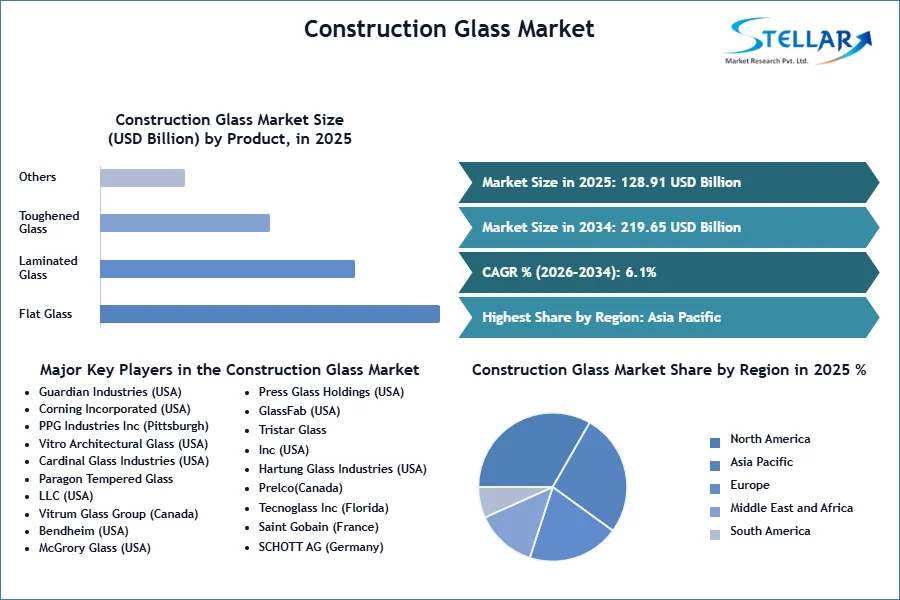
The Construction Glass Market is undergoing a structural shift toward low-carbon glazing, high-performance insulated units, and code-driven retrofits, according to a new report by Stellar Market Research. Valued at USD 128.91 billion in 2025, the market is expanding as governments tighten building thermal limits and developers cut embodied carbon across commercial and residential projects.
Architectural glass is moving from a commodity cladding material to an engineered building-envelope system that cuts heating, cooling, and embodied emissions. High interest rates and softer new-build housing starts in parts of Europe and China recently pressured commodity float volumes, but value-added processing—such as low-emissivity coatings, acoustic lamination, and multi-pane insulating units—is lifting revenue per square meter.
Key Findings from the Report
-
Market Valuation & Growth: Valued at USD 128.91 billion in 2025 and projected to grow at a 5.68% CAGR through 2035, creating multi-decade expansion across new builds and retrofits.
-
Dominant Manufacturing & Product Base: Float glass remains the primary substrate for large-scale glazing, while tempered and laminated formats anchor safety, acoustic, and structural curtain-wall specifications.
-
Fastest-Growing Segments: Insulated glass units and specialized high-performance glazing are expanding fastest as tighter U-value codes reward double- and triple-pane assemblies.
-
Regional Leadership: Asia-Pacific leads global volume and consumption on the back of urbanization, infrastructure buildouts, and green-building mandates.
-
High-Growth Emerging Markets: The Middle East and Africa, alongside fast-growing Asian economies such as India and Southeast Asia, show strong momentum from giga-projects, urban housing, and local capacity additions.
-
Buyer & Investor Relevance: Margins favor integrated glassmakers that pair scale float furnaces with value-added coating, lamination, and cullet-recovery supply chains rather than relying solely on commodity float sales.
For further information, click the following link:https://www.stellarmr.com/report/req_sample/construction-glass-market/2649
Market Drivers and Restraints
Key Drivers
-
Stricter Building Energy Codes: Updated thermal performance mandates and green-building standards require lower U-values and higher solar control, accelerating adoption of coated and insulating glass.
-
Urbanization & Retrofit Waves: Expanding urban floor area in emerging markets combines with aging building stock upgrades in mature economies to sustain steady replacement and facade demand.
-
Decarbonization & Green Certifications: Developers pursuing low-carbon benchmarks increasingly specify low-embodied-carbon glass and verified environmental declarations to reduce whole-life building emissions.
Key Restraints
-
High Capital & Energy Costs: Continuous float furnaces require heavy capital expenditure, long furnace campaigns, and high thermal energy inputs, leaving margins exposed to fuel and power price swings.
-
Logistics & Skilled Installation Bottlenecks: Moving large, fragile glass panels and executing precision curtain-wall or structural glazing installations add freight cost, breakage risk, and labor constraints.
Technology, Regulation, and Sustainability Trends
Building codes and climate policies are reshaping how architectural glass is made and specified. Regulations such as the European Union's Energy Performance of Buildings Directive, China's building energy standards, and North American energy codes push projects toward higher thermal insulation and lower operational energy use.
On the factory floor, producers are adopting hybrid electric/gas melting, oxygen-fuel combustion, heat recovery, and higher recycled cullet ratios to cut Scope 1 and Scope 2 emissions. Demand is also rising for low-carbon glass lines, dynamic/solar-control coatings, and automated optical inspection that improves yield and reduces scrap.
Regional Insights
Asia-Pacific anchors global demand and manufacturing scale, led by China's large production base and green-building rules alongside rapid construction and infrastructure expansion in India and Southeast Asia. In North America and Europe, demand leans more heavily toward commercial upgrades, code compliance, and renovation of existing buildings.
The Middle East and Africa stand out as a fast-moving growth frontier. Large-scale urban and infrastructure developments in the Gulf Cooperation Council, led by Saudi Arabia, are spurring local glass manufacturing investments to shorten supply chains and serve regional construction pipelines.
Recent Industry Developments
-
Xinyi Glass (2026): Signed a project cooperation agreement with Saudi Arabia's MODON for a USD 386 million production base covering float and high-value glass manufacturing, expanding local supply for Gulf construction and industrial demand.
-
Saint-Gobain (2026): Announced plans for a ₹2,000 crore investment in a large-scale glass facility in Andhra Pradesh, India—following its Chennai float and insulation expansion—to scale regional capacity and serve growing South Asian construction demand.
-
Sejal Glass (2026): Entered a business transfer agreement for ₹40.80 crore to acquire Magnumtuff India's architectural and automotive glass business and Belagavi plant, expanding its footprint to four Indian facilities to serve southern and western markets.
-
Şişecam (2026): Brought newly commissioned solar, flat, and coated glass investments toward full utilization while establishing Sisecam USA Trading to strengthen commercial reach in flat, solar, and value-added glass across the United States.
-
NSG Group (2026): Won the 2026 Window and Door Award for Building Glass Innovation with Pilkington Mirai Øne, a lower-carbon float glass cut by over 35% in embodied carbon versus standard baseline glass, advancing low-carbon glazing adoption.
Competitive Landscape
Competition centers on scale float manufacturing, proprietary low-E and solar-control coatings, regional processing reach, and lower-carbon production credentials. Major global players—including Saint-Gobain, AGC, NSG Group, Guardian Glass, Xinyi Glass, and Şişecam—compete through furnace upgrades, regional plant expansions, and specialty glazing portfolios.
Leading manufacturers increasingly pair upstream float capacity with downstream tempering, laminating, insulating, and recycling networks. This vertical integration helps protect margins when commodity float prices soften while meeting tighter project-level sustainability requirements.
Analyst Commentary
"Construction glass is shifting from a volume-first commodity toward a performance- and carbon-accounted building material," said a Senior Research Analyst at Stellar Market Research. "Manufacturers that pair regional processing scale with lower-emission melting and verified low-carbon glazing will capture the strongest margin resilience as energy codes tighten."
Future Outlook
Through 2035, demand for construction glass will continue to tilt toward energy-saving glazing, building retrofits, and high-growth infrastructure markets. Capital investment will focus on decarbonizing melting furnaces, expanding cullet collection, and locating finishing capacity closer to key urban and industrial hubs.
Stricter building codes and corporate carbon targets will raise the bar for product documentation and lifecycle performance. Competing effectively will require balancing cost discipline with investments in high-value coated and insulating glass capabilities.
For further information, click the following link:https://www.stellarmr.com/report/req_sample/construction-glass-market/2649
About Stellar Market Research
Stellar Market Research is a multifaceted market research and consulting company with professionals from several industries. Some of the industries we cover include medical devices, pharmaceutical manufacturers, science and engineering, electronic components, industrial equipment, technology and communication, cars and automobiles, chemical products and substances, general merchandise, beverages, personal care, and automated systems. To mention a few, we provide market-verified industry estimations, technical trend analysis, crucial market research, strategic advice, competition analysis, production and demand analysis, and client impact studies.
Address
Phase 3, Navale IT Zone, S.No. 51/2A/2, Office No. 202, 2nd floor, Near, Navale Brg, Narhe, Pune, Maharashtra 411041
Email
sales@stellarmr.com
Mobile
+91 9607365656

 Arabic
 French
 Spanish
 Portuguese
 Deutsch
 Turkish
 Dutch
 Italiano
 Russian
 Romaian
 Portuguese (Brazil)
 Greek