
Project Management Software for Engineers by Discipline: A 2026 Guide for Managers, Principals and PMO Leads
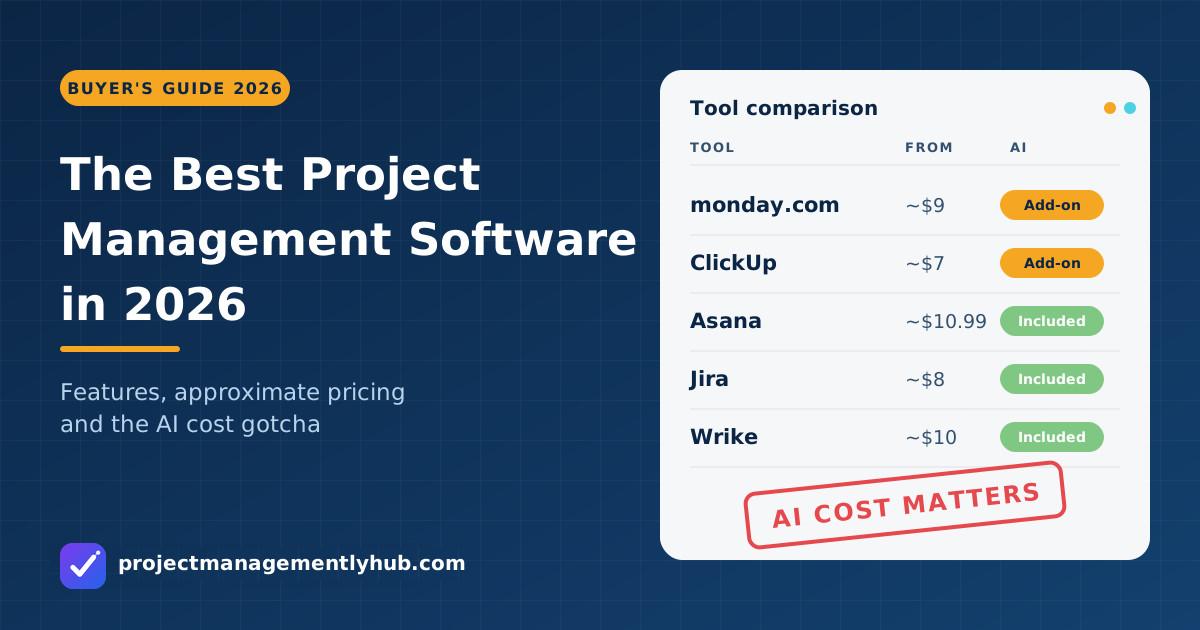
Three people are usually in the room when an engineering firm picks software. The engineering manager has eleven live projects and no clear picture of who is overbooked. The principal at a 40-person civil firm can't see utilisation until month-end. The PMO lead is trying to standardise delivery across three offices. All three need project management software for engineers, and they need different things from it. This guide separates them. The full original is here: see the full engineering software review.
What makes engineering software different?
Engineering delivery breaks in ways generic tools weren't designed for. A tool earns the "engineering" label when it handles most of these:
- Work organised around drawings, models and calculations that carry revisions, checkers and approvers.
- Schedules that model dependencies between disciplines and phases.
- Allocation by skills, certifications and partial availability, not just headcount.
- Time, rates and earned value as core data.
- Approvals and changes that leave an audit trail.
A tool with three or four of these is engineering project management software. One with none is a task manager.
What does an engineering manager need?
An engineering manager needs to see allocation across concurrent projects and to cut status meetings.
- Float: a drag-to-reallocate timeline showing who is available and what happens if you move them. About $7 to $12 per scheduled person per month, with free viewer seats.
- monday work management: dashboards that show budget burn, change requests and milestones across twenty projects on one screen.
- Smartsheet: familiar grids, with Control Center blueprints that set up every new project in minutes.
Build a live dashboard and an automated weekly digest, and don't repeat on a call anything the dashboard already shows.
What does a principal need?
A principal needs to know whether each project is making money while there's still time to act. Realisation rate, utilisation and unbilled work in progress matter more than schedule adherence.
- BQE CORE: the best fit for firms of about 10 to 75 people billing by the hour, with one-click time capture feeding contract-aware invoicing.
- Deltek Vantagepoint: one record from pursuit through invoice and revenue recognition, for mid-size and large firms.
- Unanet A/E: built for government contracts, with timesheet audit trails that satisfy DCAA review.
- Kantata: estimate-versus-actual tracking from week two, for consultancies of 50 or more people.
Only these four carry a project from plan through timesheet to invoice in one data model.
What does a PMO lead need?
A PMO lead needs standard templates, intake and portfolio reporting.
- Smartsheet: Control Center blueprints enforce a consistent project structure.
- Wrike: dynamic request forms and cross-tagging, so one task reports to both its project and its discipline.
- Oracle Primavera: the contractual CPM standard for capital projects, with native earned value.
Which tool for which discipline?
- Civil and structural: Primavera, Procore or Autodesk Construction Cloud, plus Deltek or BQE CORE.
- MEP: Autodesk Construction Cloud for clash detection, plus monday or Wrike.
- Manufacturing and R&D: Wrike or monday, integrated with PLM.
- Software and firmware: Jira.
- Aerospace and defence: Primavera or Plan 5, Unanet or Deltek, and OpenProject where self-hosting is mandatory.
- Small teams on a budget: Zoho Projects ($4 per user), ClickUp ($7) or monday Standard ($12).
What will it cost?
Entry tools run $4 to $10 per user per month, mid-market tools $12 to $25, and premium scheduling and portfolio tiers $30 to $55. Industry platforms are quoted, typically $15,000 to $150,000 or more a year. Implementation and migration add 15 to 50% to first-year cost, and ERP-class platforms often add more. Prices verified July 2026; confirm with vendors.
What should you ask in a demo?
- Show me a schedule with 500+ activities, four calendars and a saved baseline.
- How does the system stop someone working from a superseded revision?
- Is the CAD or BIM integration a live two-way sync or a file link?
- Can a subconsultant see their package and nothing else?
- Which features in this demo aren't in the plan you're quoting?
How do you avoid a bad purchase?
- Name your dominant constraint: scheduling, capacity, deliverable control or financial visibility.
- Screen for compliance (DCAA, ISO 19650, ITAR, data residency) in week one.
- Pilot one real project for 30 days with no parallel spreadsheet.
- Name an owner for configuration and training.
Frequently asked questions
Can general project management software work for engineers? Yes, if your work is mainly task coordination. Once drawings, revisions and billable hours matter, you'll want engineering-specific control.
What should a 25-person firm budget? Roughly $3,000 to $7,500 a year on a horizontal platform, or $25,000 to $60,000 all-in for an industry platform including implementation.
Next step
Choose by your dominant constraint, pilot on a real project and ask for a three-year cost. For pros, cons and verdicts on all 16 tools, see the full engineering software review.

 Arabic
 French
 Spanish
 Portuguese
 Deutsch
 Turkish
 Dutch
 Italiano
 Russian
 Romaian
 Portuguese (Brazil)
 Greek