
Military Discone Antenna: Picking the Right Frequency Span
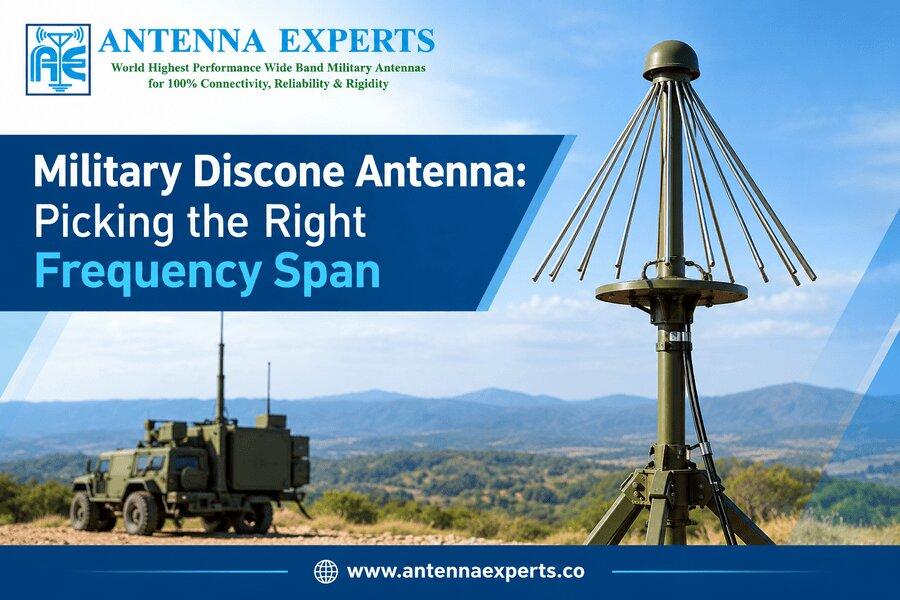
First, the required frequency range is selected for the military discone antenna. A model that covers frequencies only up to 500 MHz will not work with a receiver that needs 900 MHz. Similarly a model that starts at 100 MHz will not cover the VHF band of 30-88 MHz.
The models from Antenna Experts cover narrow slices of spectrum up to very broad spans. Each covers a different portion of the spectrum, so the right choice depends on the radios, receivers or monitoring sets it will be used with.
This post discusses matching a model to your frequency band and application. Read while you browse the entire selection of military discone antennas. See our discone antenna basics guide for the design background.
Why the Frequency Range Is Important in a Military Discone Antenna
The range of frequencies dictates which signals an antenna can receive or transmit. An antenna may not work as intended outside its specified band.
VHF and UHF are not a single requirement. A 135-175 MHz model will not work for a 400 MHz link, although both are loosely "VHF/UHF" work.
Verify the stated operating band not the product category name. Just list the lowest and highest frequency that your equipment has to handle and compare that range with the range of each model.
Model Explains Frequency Coverage of Discone Antenna
The numbers in a model name represent the lower and upper limits in MHz. Check each figure on the data sheet before ordering.
On the product category page, it mentions the total range from 20 to 6000 MHz. That is the extent of the whole category. No one standard fits the bill for all of it.
Narrow Band Models
Three models for specific bands:
- AWD-30-88: 30-88 MHz
- AWD-135-175: 135-175 MHz
- AWD-300-500: 300 to 500 MHz
If your radios are operating within one defined band, then a narrow-band model is the closer match. For example a VHF network in the 30-88 MHz range does not require coverage up to 1 GHz.
Wide-Band Model
Wide-band models serve scanning and monitoring applications well, where signals of interest are spread over a large span. We have AWD-30-512, AWD-66-512, AWD-50-500, AWD-20-500, AWD-88-1000, AWD-30-1000, AWD-20-1000.
Look at where each one begins. AWD-20-500 is lower than AWD-66-512 and AWD-88-1000 is higher than both. Choosing a wide band discone antenna is a matter of deciding which end of the span is more important to you.
Microwave and Higher Frequency Models
Some requirements are higher than 1 GHz. The models include the AWD-100-1300, AWD-20-1300, AWD-25-1300, AWD-100-2000, AWD-30-2000, AWD-500-2000, AWD-300-3000, WD-300-3000 and the compact CWD-20-500.
Compare the two limits. The AWD-20-1300 discone antenna starts low and goes above 1 GHz, while AWD-500-2000 starts at 500 MHz and goes to 2 GHz. A high upper limit is of no use if your lowest frequency is below the start of the model.
Receive vs. Transmit Military Application
Discone antennas can be used for receiving and if the model is so specified, transmitting. Not all models are suited to all gearbox applications.
Before you transmit, check four things on the datasheet: frequency compatibility, impedance, VSWR and how much transmitter power the antenna can handle. Before installation, check the desired operating mode.
Scanning and monitoring are passive functions. They need wide coverage, but no power handling. Active radio links pose power, match and compliance questions, which have to be sorted out first.
Gain and Omni-Directional Coverage
2.15 dBi omni gain is achieved for the models mentioned. It is very modest, not to be interpreted as a large gain.
It's the way of the world. An omnidirectional wideband antenna does not radiate its energy in one direction but over the whole horizon. This can be useful when signals may come from any bearing, such as in monitoring.
Don’t buy for the sake of profit alone. The actual results will depend on the radiation pattern and the operating frequency. A directional antenna might be better for a fixed link.
Site Selection and Mounting Height
Mount the antenna as high as practical with a clear view all around. Nearby masts, buildings, cars and other metallic objects can distort the pattern and reduce performance.
Also plan the rest of the install:
- Loss and cable length at your highest frequency
- Compatibility of the connector with your cable and equipment
- Mechanical support adapted to the site and local wind exposure
- A mounting arrangement for the vehicle, mast or fixed location
For site installs, keep the site layout simple and test before you rely on it. Always check the datasheet and installation recommendations before deploying.
Why Antenna Experts?
Antenna Experts is an antenna manufacturer in India. Our military discone antenna range is divided according to frequency span. We have narrow-band, wide-band and higher frequency models so that buyers can start with their own requirements rather than a generic product.
We invite you to compare frequency coverage, gain, radiation pattern and use. To narrow your choices, write down your lowest and highest frequency, decide if you will only be receiving or will be transmitting too, and write down your mounting site. Then give us those details and ask for the appropriate datasheet.
Common Questions
- What frequencies can a military discone antenna cover?
Depends on the model. On our category page we list a range of 20-6000 MHz overall, but individual models cover specific bands like 30-88 MHz or 300-500 MHz. There is no one model that covers the whole range.
- Can I use a discone antenna for transmitting?
Yes, if that specific model is designed and rated for the frequency, power, impedance and operating conditions required. Because not every model is suited for every transmitting application, check the data sheet first.
- Why is the gain of discone antenna low?
Its omnidirectional pattern radiates energy around the horizon rather than concentrating it, so gain is still modest at 2.15 dBi. Beyond the radiation pattern and the frequency Think judge gain against the application not the only selection factor.
- Which discone for the VHF band 30-88 MHz?
30-88 MHz is designated AWD-30-88. Make sure to check the datasheet and your installation requirements before you opt for it.
About the Author
Antenna Experts is the best antenna manufacturer in India. We offer military and communication antennas for different frequency ranges and applications. We help technical buyers find suitable antenna solutions through product specifications and datasheets.

 Arabic
 French
 Spanish
 Portuguese
 Deutsch
 Turkish
 Dutch
 Italiano
 Russian
 Romaian
 Portuguese (Brazil)
 Greek