
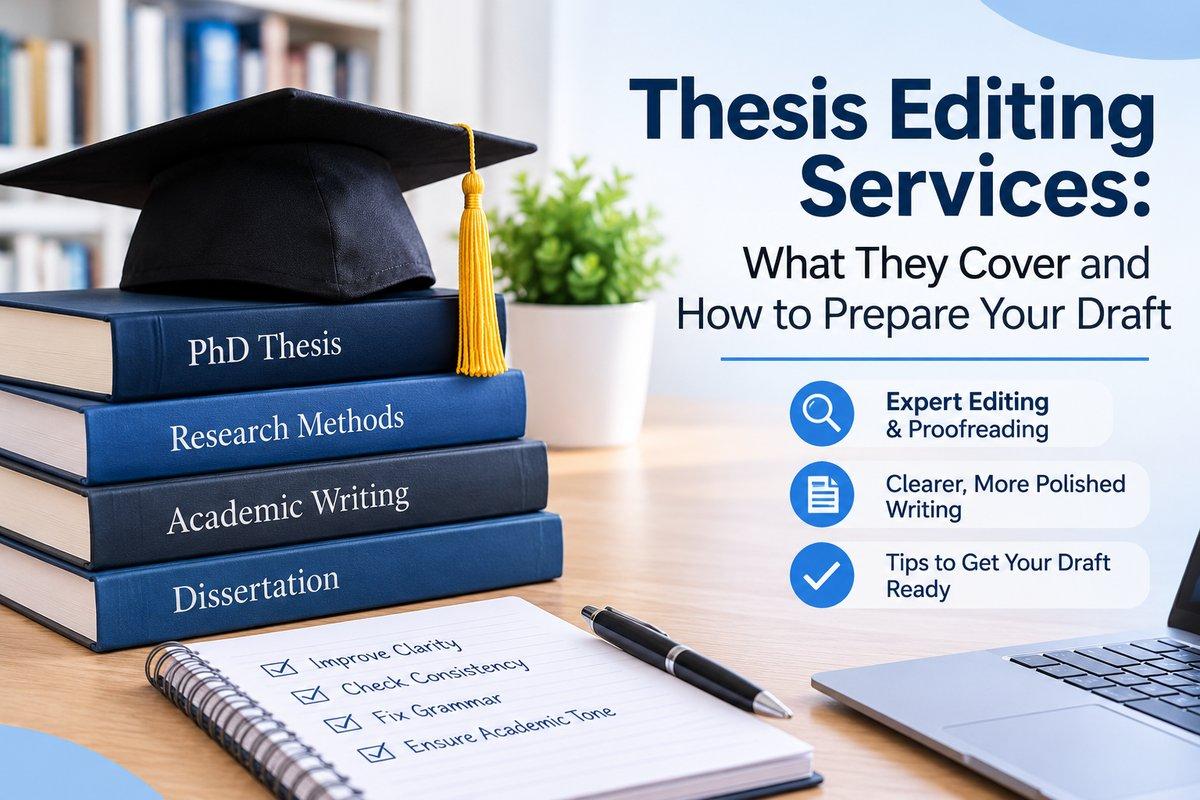
Thesis Editing Services: What They Cover and How to Prepare Your Draft
By the time a thesis is nearly finished, its author has read it so many times that the problems have stopped being visible. A results chapter still uses the wording of an earlier research question. The people in Chapter 3 are “participants”, but by Chapter 6 they have become “respondents”. The abstract describes the study that was planned rather than the one that was carried out. Examiners tend to notice exactly these things.
That is often the point at which students begin looking into thesis editing services. This article explains what editing involves, which mistakes are easiest to miss, how to work through a draft on your own, and what to check before anyone else touches your text.
What researchers are usually up against
Three problems come up again and again in thesis writing. The first is familiarity: after months or years with the same document, you read what you meant to write rather than what is on the page. The second is time. Chapters are drafted at different stages, sometimes adapted from journal articles, so conventions drift without anyone deciding they should. The third is uncertainty about the rules. Many students are unsure how much outside help is allowed, and that doubt can be a bigger obstacle than the writing itself.
Understanding what each stage of revision is for resolves a good part of this.
Editing versus proofreading: two different jobs
The UNC Writing Center treats these as separate stages. Editing deals with ideas, organisation and how well the writing communicates. Proofreading is the last check for surface errors such as misspellings and punctuation slips, and it should happen only after the other revisions are finished.
The order matters more in a thesis than in an essay. Move a section and page numbers, figure numbers, cross-references and citations can all shift. Proofreading before the structure is settled means doing the work twice. Most editing and proofreading services scope and price these tasks separately, so knowing which one your draft needs saves money and avoids disappointment. A draft with open questions about its argument needs a different kind of attention from one that is complete and only needs a clean final read.
Mistakes that are easy to miss in your own draft
- A promise the thesis does not keep. The introduction sets out three research questions, but the discussion answers two. Often the aims were refined during analysis and the first chapter was never updated.
- Drifting terminology. “Adherence”, “compliance” and “engagement” can look interchangeable, yet in many fields they are distinct constructs. Variation that feels like good style can read as a change of meaning.
- Claims out of proportion to the evidence. The University of Manchester’s Academic Phrasebank explains why cautious language matters. “Suggests”, “indicates” and “demonstrates” signal different levels of support. The opposite fault is a stack of hedges (“it could perhaps be argued that…”) that hides a finding you are entitled to state.
- Results repeated rather than interpreted. Newcastle University’s thesis advice separates reporting observations from interpreting them. If your discussion reads like the results chapter in longer sentences, the interpretation is missing.
- The main point arrives last. A paragraph builds through evidence and only states its claim in the final line. Move the claim to the front so the reader knows what the evidence is for.
- Tense and voice shifts, especially in methods and literature review sections written over several months.
- References that no longer match. Deleted paragraphs leave orphaned entries, and merged bibliographies bring imported errors with them.
- Leftover conventions from published chapters. US spelling, journal-specific abbreviations and numbered reference styles can survive inside a thesis that follows different rules.
Clarity and academic tone
Academic tone is often mistaken for complexity. A formal register means precise, measured and impersonal where appropriate. It does not require long sentences or stacked abstract nouns.
A useful test is to write three notes beside each paragraph: its claim, its evidence and the research question it serves. If you cannot fill all three, the reader will struggle too.
Here is a typical sentence from a methods chapter: “The implementation of the intervention was undertaken by ward nurses over a period of six weeks.” Compare it with: “Ward nurses delivered the intervention over six weeks.” Nothing is lost, and the person doing the action is visible again. Passive voice is not a fault in itself, and methods sections often need it. The point is to choose it deliberately.
Be careful when shortening. A term that looks like padding may have a defined meaning in your discipline, and “significant” is the classic case. State whether you mean statistical significance, practical importance or something else, because each rests on different evidence.
Consistency: keep a style sheet
A style sheet is a one-page record of decisions made once and applied everywhere. It does not need to be elaborate. Include:
- the spelling variety (UK or US) and any exceptions for quotations
- the full form and abbreviation of every technical term, fixed at first use
- capitalisation of headings and key terms
- units, number formats and decimal places
- the citation style and how you treat multiple authors
When you search for a variant, review each result in context instead of replacing all. A global replacement can quietly alter a direct quotation, a measurement label or a word another author used on purpose. Quotations and included publications often need their original wording preserved, even when it clashes with the rest of the thesis.
A self-editing sequence that works
The order below keeps you from polishing text you may later cut.
- Structural pass. Make a reverse outline: one sentence per paragraph, then read only those sentences. Gaps, repetition and unanswered questions become obvious. Check that the abstract, introduction and conclusion describe the same study.
- Clarity pass. Apply the claim, evidence and question test. Shorten tangled sentences and move main points forward.
- Consistency pass. Check terms, abbreviations, tense, spelling and numbers against your style sheet.
- Reference audit. Match every in-text citation to its list entry and back again. Confirm quoted page numbers against the source, and check figure and table numbering.
- Proofread. Leave a gap of at least a day, if you can. Read aloud, work through the text one sentence at a time starting from the end, and look for one type of error per pass. The University of Central Florida Writing Center also suggests changing how the text looks, for example by printing it or switching typeface, so it feels unfamiliar.
- Final file check. Regenerate the contents page and lists of figures, then read the exported PDF page by page. Layout problems often appear only at this stage.
For a closer look at this process, including examples of how structure, terminology and references interact, see these thesis editing tips for clarity and consistency.
What thesis editing services can and cannot do
Before you pay for any outside help, find out what your institution permits. Policies differ, and the differences are significant.
In Australia and New Zealand, the Institute of Professional Editors’ guidelines for editing research theses say professional intervention should be limited to copyediting and proofreading, with the supervisor’s approval evidenced for the editor. Editing assistance should also be acknowledged in the thesis. The University of Otago requires students to give its guidelines to the person they hire. In the UK, the University of Dundee’s proofreading policy permits specified checks but does not allow a proofreader to change ideas, discussion or structure.
The pattern is consistent. Responsible thesis editing services work on language, consistency, referencing and presentation. They do not decide what your argument is, rewrite your analysis or supply content. You remain responsible for every scholarly choice and for every suggested change you accept. Any editing and proofreading services worth considering will ask for your university’s regulations before quoting.
These are examples, not a universal rule. Your own research-degree regulations are the authority, and a supervisor can usually clarify grey areas before you commit.
How to choose a thesis editor
A few practical checks make the decision easier:
- Scope in writing. Which tasks are included, and which are not? Ask for it before work starts.
- A sample. A short test edit on a few pages shows how the editor handles your discipline and your voice.
- Visible changes. Tracked changes and comments let you see, and accept or reject, every suggestion.
- Subject familiarity. An editor does not need to be an expert in your field, but should recognise how technical terms and reporting conventions work in it.
- Turnaround that includes your time. Allow days to review suggestions, answer queries and re-check references after changes.
- Confidentiality. Unpublished research is sensitive. Ask how files are stored and who sees them.
- Realistic promises. Be wary of anyone who guarantees a grade or a pass, or who offers to rewrite your arguments. Cost depends on length, complexity and the state of the draft, as IPEd notes, so compare quotes on scope rather than on price alone.
When you approach an editor, send your university’s regulations, any supervisor approval, your style sheet, the referencing style, the deadline and the chapters you want checked. The clearer the brief, the less time is spent guessing.
If you also need layout help, such as heading styles, figure presentation or reference formatting, treat it as a separate request and give the editor your institution’s actual specifications. A generic template cannot guarantee compliance.
Conclusion
A thesis does not need perfect prose to succeed, but it does need an argument the reader can follow, terms that stay stable, and evidence that matches its claims. Most of the work that achieves this is within your control: check structure first, clarify at paragraph level, fix your conventions in a style sheet, audit your references, and proofread last.
Outside help is worth considering when you have run out of fresh eyes or time. Thesis editing services are most useful when they work within your university’s rules, when you know what you are asking them to do, and when you keep the final decisions. Check the rules, set the scope, and give yourself time to review every change.

 Arabic
 French
 Spanish
 Portuguese
 Deutsch
 Turkish
 Dutch
 Italiano
 Russian
 Romaian
 Portuguese (Brazil)
 Greek