
AMC Exam Success Story: How a Nepal Medical Officer Turned Setbacks into Success
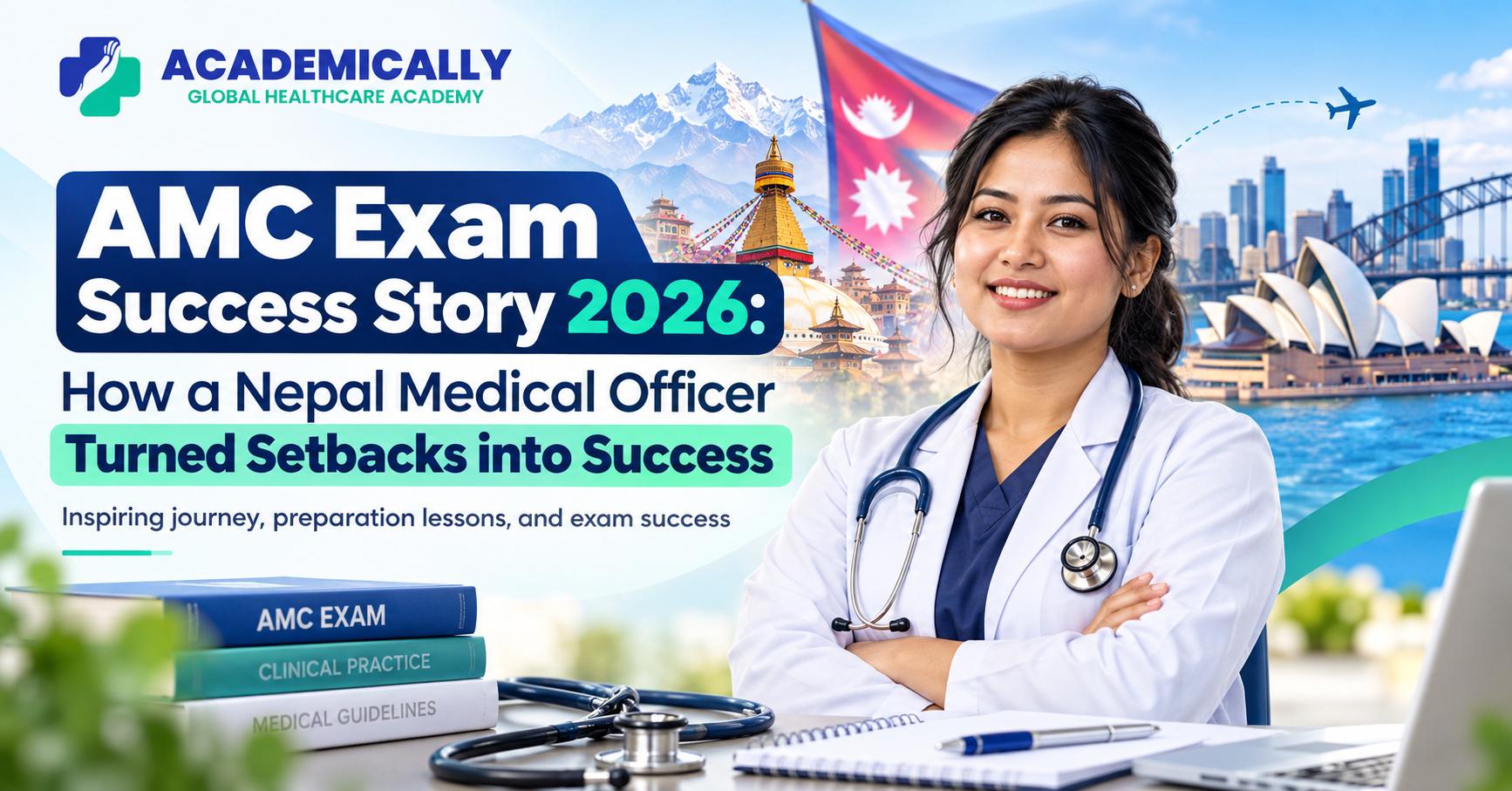
Preparing for the Australian Medical Council (AMC) examination is a significant step for international medical graduates who want to pursue medical careers in Australia. The process requires clinical understanding, careful preparation and the ability to make sound decisions under examination pressure.
However, not every successful candidate passes on their first attempt.
Dr. Dibyadristi, a medical officer from Nepal, experienced this challenge firsthand. After narrowly missing the required passing score during her first attempt, she reassessed her preparation approach and successfully cleared the AMC exam in September 2026.
Her journey offers practical lessons about persistence, effective learning resources and the importance of clinical reasoning.
From Nepal to the Australian Medical Career Pathway
Before preparing for the AMC examination, Dr. Dibyadristi had developed considerable experience in healthcare.
She worked as a medical officer in Pokhara, Nepal, including several years in intensive care settings. Her professional background also included teaching physiology and nursing students at a medical college.
Additionally, she gained international exposure through a short observership in Italy.
Despite having clinical experience, choosing an international medical career pathway required careful consideration.
Australia eventually became her preferred destination because of its healthcare environment, lifestyle and potential for a better work-life balance.
Encouragement from senior doctors already working in Australia further influenced her decision.
The First AMC Exam Attempt: What Went Wrong?
Dr. Dibyadristi's initial examination attempt was unsuccessful by only a few marks.
Although she possessed a strong medical background, she found it challenging to identify trustworthy preparation resources and develop a consistent examination strategy.
The result was discouraging, and she briefly considered abandoning her plans.
However, the experience helped her recognise an important distinction: possessing medical knowledge and applying that knowledge during a competitive clinical assessment are not always the same.
Rather than repeating her previous routine, she decided to change how she studied.
How She Improved Her AMC Exam Preparation
For her second attempt, Dr. Dibyadristi joined Academically Global and adopted a more structured approach to learning.
Several changes contributed to her improved preparation.
1. Following a Consistent Study Schedule
She dedicated approximately six hours daily to preparation.
Rather than studying without direction, she followed a timetable that incorporated clinical concepts, practice questions and revision.
Her experience highlights the value of consistency, although the ideal daily study duration depends on individual circumstances.
2. Practising with Mock Tests
Regular mock examinations became an important part of her study routine.
These assessments helped her recognise knowledge gaps, compare similar answer choices and become more comfortable interpreting clinical scenarios.
Instead of treating mock-test scores as the only measure of progress, she used the results to identify topics requiring further attention.
3. Improving Clinical Reasoning
The AMC CAT MCQ examination places considerable emphasis on interpreting patient presentations and selecting appropriate clinical actions.
Dr. Dibyadristi found questions involving the most appropriate next step particularly challenging.
She therefore focused on understanding the reasoning behind clinical decisions rather than relying entirely on memorised answers.
This approach helped her develop greater confidence when encountering unfamiliar scenarios.
4. Learning from Mentor Feedback
Faculty-led review sessions helped her identify specific weaknesses.
After completing grand tests, she received guidance on topics needing improvement and clarified difficult medical concepts.
Such feedback can be valuable because candidates may not always recognise weaknesses through independent study.
5. Studying with a Dedicated Partner
Another important part of her journey was the support of Dr. Prapti, a fellow candidate from India.
They discussed medical topics, reviewed difficult questions and supported each other throughout preparation.
Both subsequently passed the examination.
Their experience demonstrates how collaborative learning can improve accountability and encourage deeper understanding.
Understanding the AMC MCQ Examination
The Australian Medical Council CAT MCQ examination assesses the medical knowledge and clinical decision-making abilities of international medical graduates.
It consists of 150 multiple-choice questions completed within 3.5 hours.
The assessment covers major clinical areas, including internal medicine, surgery, paediatrics, psychiatry, general practice, and obstetrics and gynaecology.
Candidates must apply medical knowledge to patient scenarios and identify appropriate investigations, diagnoses or management decisions.
For this reason, effective AMC preparation should combine subject revision with regular clinical question practice.
Practical Lessons for Future AMC Aspirants
Dr. Dibyadristi's journey suggests that candidates should evaluate their study methods regularly rather than continuing with an ineffective approach.
Selecting reliable resources, reviewing incorrect answers and practising time management can make preparation more focused.
She also found concise revision notes useful for reinforcing important concepts.
Most importantly, candidates should not interpret one unsuccessful attempt as a permanent barrier to their professional goals.
What Happens After Passing the AMC Exam?
Clearing the AMC MCQ examination is an important milestone, but it does not automatically provide medical registration in Australia.
International medical graduates following the Standard Pathway generally need to complete the AMC Clinical Examination or an approved workplace-based assessment, alongside applicable registration requirements.
After passing the written examination, candidates should review their individual eligibility, future assessments, employment options and registration obligations.
Frequently Asked Questions About the AMC Exam
1. Can doctors from Nepal apply for the AMC exam?
Yes. Eligible medical graduates from Nepal can pursue the Australian Medical Council assessment pathway, provided their medical qualifications meet the applicable requirements.
2. How did Dr. Dibyadristi pass the AMC examination?
She improved her preparation through structured study, mock examinations, clinical reasoning practice, faculty feedback and collaborative learning.
3. How many attempts did she need to pass?
Dr. Dibyadristi passed the AMC MCQ examination on her second attempt in September 2026.
4. Are mock tests important for AMC preparation?
Yes. Mock tests help candidates identify knowledge gaps, improve examination timing and practise clinical decision-making under realistic conditions.
5. Does passing the AMC MCQ exam guarantee a medical job in Australia?
No. Candidates must satisfy additional registration and employment requirements. Passing the MCQ examination alone does not guarantee employment or independent practice rights.
Conclusion
Dr. Dibyadristi's September 2026 AMC exam success illustrates how revising an ineffective preparation strategy can lead to meaningful progress.
After narrowly missing the passing score, she strengthened her clinical reasoning, followed a disciplined routine and used feedback to improve her performance.
For international medical graduates preparing for Australia, her experience provides a valuable reminder that successful preparation involves more than studying extensively. It requires reliable resources, regular assessment and the willingness to learn from mistakes.

 Arabic
 French
 Spanish
 Portuguese
 Deutsch
 Turkish
 Dutch
 Italiano
 Russian
 Romaian
 Portuguese (Brazil)
 Greek