
Residential Plots in Sohna Gurgaon: What Buyers Should Check Before Buying
Buying a residential plot is different from buying a completed apartment.
With an apartment, buyers can usually see the building, common areas and the home they may eventually occupy. With a plot, a large part of the decision depends on documents, infrastructure, location, development stage and what can legally be constructed on the land.
This is particularly important for buyers researching residential plots in Sohna Gurgaon, where options can include plots in established colonies, newer gated developments, DDJAY projects and independent land.
Two plots located only a few kilometres apart may have similar sizes but very different prices, approvals and construction readiness.
Before choosing a plot, buyers should compare the complete picture rather than focusing only on the advertised rate.
Why Are Buyers Exploring Residential Plots in Sohna?
Sohna has developed into an important residential area within the wider Gurugram property market.
One reason buyers consider plots is the flexibility of building an independent home according to their own requirements.
A family may want additional parking, a home office, rooms for parents, outdoor space or a different floor plan from what is normally available in an apartment.
A plot can provide this flexibility, subject to the applicable building regulations.
However, land ownership also comes with additional responsibilities.
The buyer may need to understand:
-
plot dimensions and boundaries;
-
permitted residential use;
-
project approvals;
-
construction rules;
-
road access;
-
availability of utilities;
-
possession conditions; and
-
future building costs.
This is why buyers should view a plot as both a property purchase and a future construction project.
Plot Price Should Not Be the Only Comparison
One of the most common mistakes is comparing plots only by total price.
Suppose one plot costs ₹1.30 crore and another costs ₹2 crore.
The first may initially appear more affordable.
But the second plot may be larger, located on a wider internal road, have clearer development infrastructure or sit inside a planned residential community.
The correct comparison should include the price per square yard as well as the overall property conditions.
For example, a 120-square-yard plot costing ₹1.44 crore works out to approximately ₹1.20 lakh per square yard.
A 150-square-yard plot costing ₹1.65 crore works out to approximately ₹1.10 lakh per square yard.
The larger plot has a higher total price but a lower price per square yard.
That still does not automatically make it better.
Buyers should also compare road width, plot shape, location inside the project, approvals, infrastructure and possession conditions.
What Additional Costs Should Buyers Calculate?
The advertised plot price may not represent the complete acquisition cost.
Depending on the property and transaction, additional expenses can include stamp duty, registration fees, legal verification, project-related charges and future construction expenses.
A buyer planning to build a house should create two separate budgets.
The first should cover the land purchase and registration.
The second should cover construction.
Future building expenses can include architectural planning, building approvals, structural work, labour, materials, utilities and interior completion.
This distinction is important because a buyer who spends almost the entire budget on the plot may later find that construction requires substantially more capital.
Sector 4 and Sector 5 Sohna
Sectors 4 and 5 are commonly researched by people comparing plotted housing in Sohna.
Both areas contain multiple residential developments, but buyers should not assume that every project within a sector offers the same conditions.
Sector 4 Sohna
Sector 4 includes different plotted residential developments and resale options.
Some locations may have more visible residential activity, while others may still be developing.
Buyers should inspect the selected colony rather than judging the property only by its sector name.
Important factors include existing roads, services, neighbourhood development and actual construction activity.
Sector 5 Sohna
Sector 5 also contains several plotted projects and resale options.
This gives buyers the opportunity to compare multiple communities within the same micro-market.
Projects can still differ substantially in plot size, infrastructure, development stage, possession schedule and community facilities.
A buyer planning immediate construction may prefer a property with more advanced infrastructure.
Someone purchasing for future use may be comfortable with a project that is still under development.
DDJAY Plots and Independent Plots Are Not the Same
Buyers researching Sohna often come across the term DDJAY.
Deen Dayal Jan Awas Yojana is a Haryana policy framework associated with eligible plotted residential developments.
However, simply seeing the term DDJAY in an advertisement should not be treated as proof of approval.
Buyers should verify the relevant development licence, approved layout and Haryana RERA registration where applicable.
Independent residential land requires a different level of due diligence.
A plot sold by an individual owner may be perfectly suitable for residential use, but buyers should verify the title, ownership history, land use, legal road access and construction permissions.
Agricultural land marketed as a future residential plot should not automatically be treated as equivalent to a plot inside a licensed residential colony.
What Does a Gated Plotted Community Offer?
Some buyers prefer plotted developments that include shared facilities.
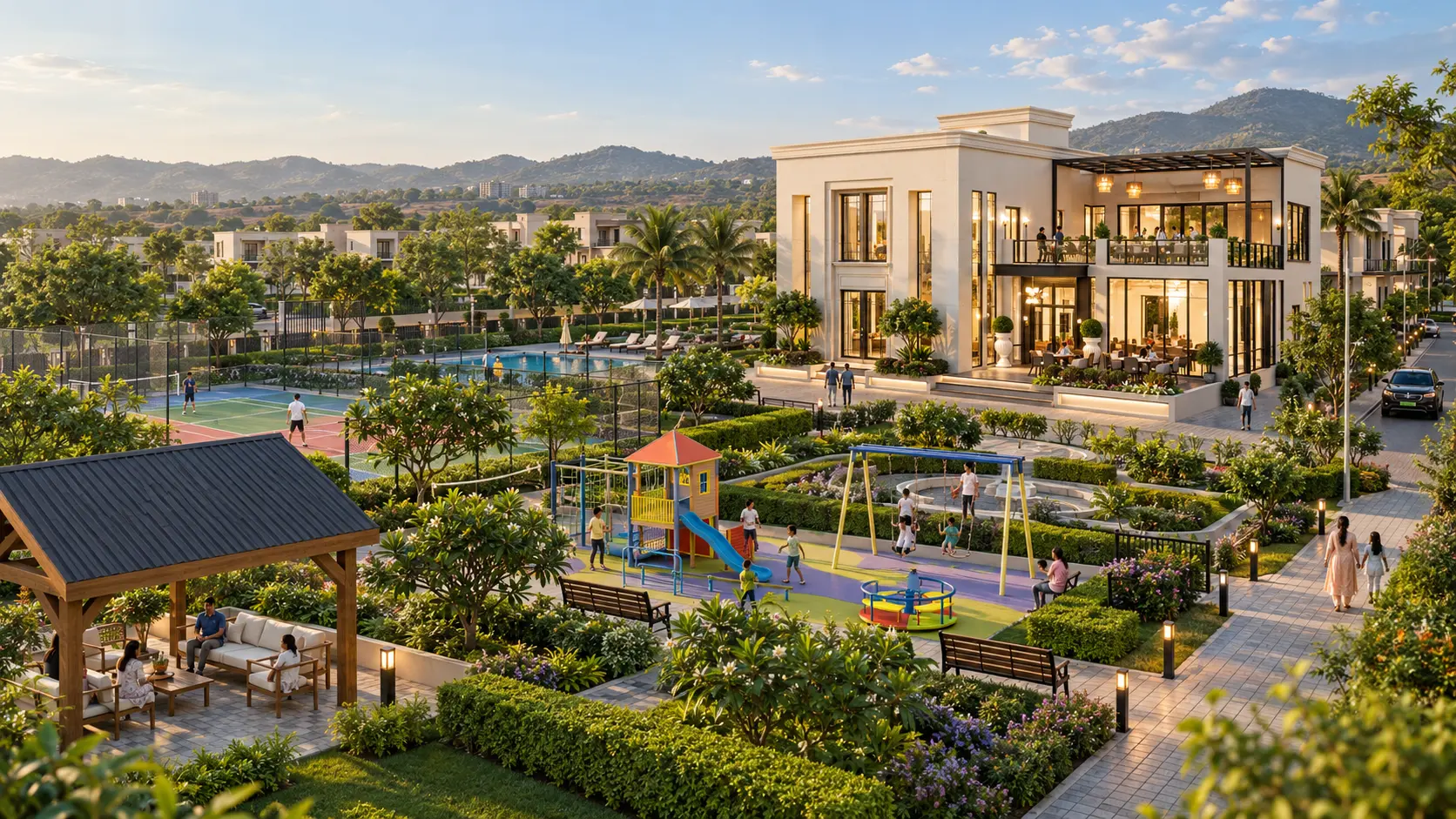
These projects may provide internal roads, controlled access, landscaped areas, parks, recreation spaces and community facilities.
For families planning to build an independent house, this can offer a different living environment from an isolated plot.
However, amenities should be verified carefully.
A clubhouse shown in a brochure may still be under construction.
Landscaped parks may be part of the future development plan rather than facilities already available.
Buyers should ask:
Which facilities are approved?
Which facilities have been completed?
When are the remaining amenities expected?
Who will maintain them?
What maintenance charges may apply?
These questions help buyers distinguish between planned facilities and usable facilities.
How Should Buyers Check Project Approvals?
Legal verification should take place before a substantial payment.
For a plot within a planned residential development, buyers should examine the applicable development licence and sanctioned layout.
The exact plot should appear correctly on the approved plan.
Where the project falls under RERA, its registration details should also be checked through the official Haryana RERA portal.
Land ownership documents should be reviewed separately.
These documents do not all prove the same thing.
A development licence relates to permission to develop the colony.
A sanctioned layout shows how plots, roads and other areas are planned.
RERA registration provides regulatory information about the project.
Ownership documents establish the legal rights of the seller or promoter over the land.
A complete property review may require all of them.
Why Site Inspection Still Matters
Documents are essential, but buyers should also inspect the physical site.
During the visit, examine the approach road first.
Then check the internal roads, drainage, electrical infrastructure, water arrangements and surrounding development.
A development may have underground pipelines installed without individual water connections being active.
Similarly, an internal road may appear on an approved plan while actual construction is still incomplete.
Buyers planning to construct soon should ask whether construction vehicles can access the site and whether temporary electricity and water arrangements are available.
The surrounding area also matters.
Existing houses, local markets, schools, hospitals and regular traffic can give buyers a clearer idea of how practical the location may be for everyday living.
AQVA The Reserve as a Sector 5 Example
Buyers comparing plotted communities in Sector 5 may also come across AQVA The Reserve.
The project is positioned as a planned residential plotted community in Sector 5, Sohna.
Instead of evaluating it only by project imagery or amenities, buyers should compare it using the same criteria applied to other plotted developments.
These include plot dimensions, pricing, regulatory information, current infrastructure, possession timeline and the stage of development of shared facilities.
This comparison-based approach is more useful than assuming that a newer gated community is automatically better than an established resale colony.
For some buyers, planned facilities and larger plots may matter more.
For others, immediate construction readiness or a lower purchase price may be more important.
Questions Buyers Should Ask Before Booking
Before finalising a residential plot in Sohna, buyers should be able to answer the following questions:
-
Who legally owns the land?
-
Is the property approved for residential use?
-
Does the selected plot appear on the approved layout?
-
Is the project registered with Haryana RERA where required?
-
What is the actual price per square yard?
-
What additional charges apply?
-
When will possession be given?
-
What infrastructure is available today?
-
When can construction legally begin?
-
What will the total cost be after registration and construction?
If several of these questions remain unanswered, the buyer should continue the due-diligence process before making a major payment.
Final Thoughts
Residential plots in Sohna Gurgaon can suit different types of buyers.
Some people want land to construct a family home.
Others may be buying for future use or holding the property for several years.
The right plot depends on the buyer's budget, timeline, preferred location, construction plans and comfort with an under-development area.
The lowest-priced plot is not always the best value.
Similarly, the development with the longest list of amenities is not automatically the most suitable option.
A stronger decision comes from comparing the actual plot, approved documents, infrastructure, total purchase cost and future construction requirements.
Buying land should therefore begin with verification rather than marketing.
The goal is not simply to find a plot.
It is to understand exactly what you are buying, what you can legally do with it and how it fits your long-term plans.

 English
 Arabic
 French
 Spanish
 Portuguese
 Deutsch
 Turkish
 Dutch
 Italiano
 Russian
 Portuguese (Brazil)
 Greek