
Why Should Egyptian Enterprises Treat Application Development as a Long-Term Technology Investment?
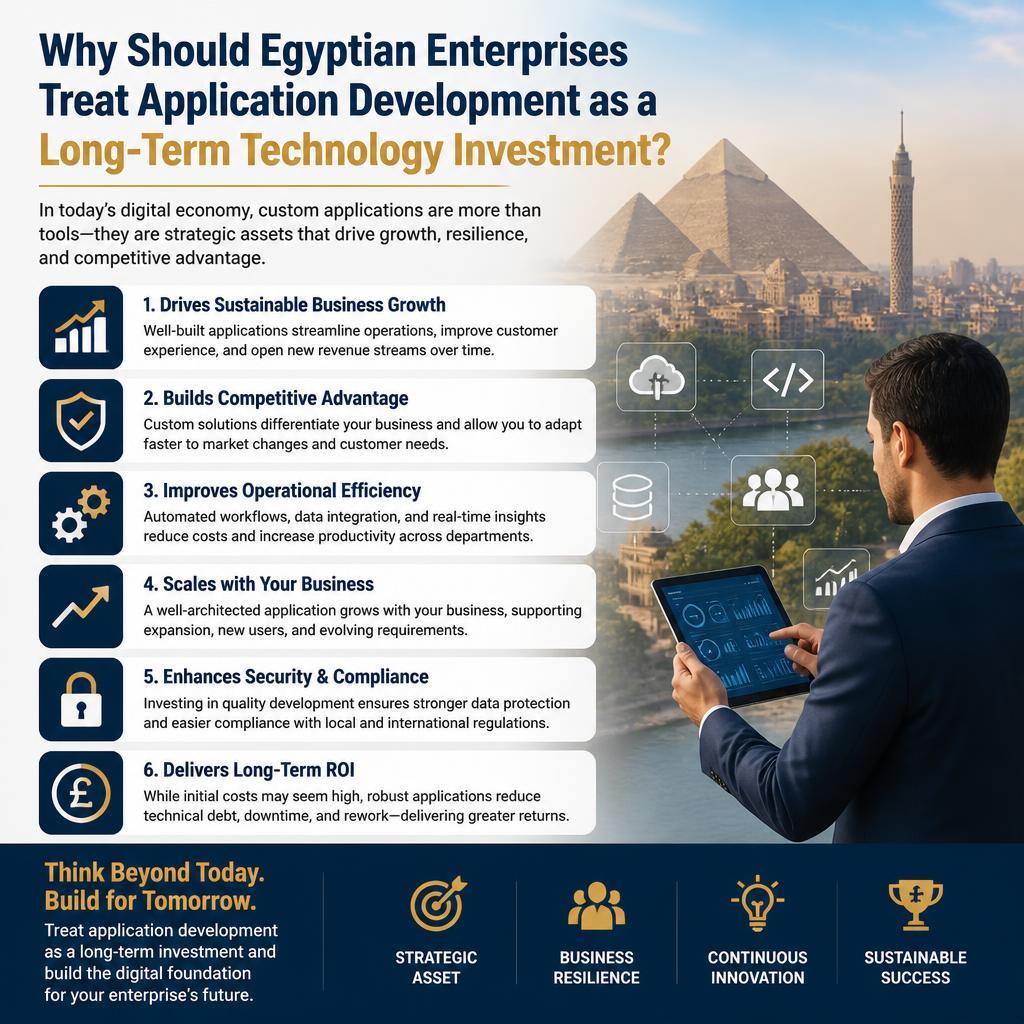
For modern enterprises, software is no longer simply a tool for completing routine tasks. It influences operational efficiency, customer satisfaction, information security, and the ability to respond to changing market conditions. Across Egypt, organizations are increasingly recognizing that application development deserves the same long-term planning as other essential business investments.
Companies operating in Cairo, Alexandria, Giza, and other Egyptian commercial centers often face evolving customer expectations, growing competition, and increasing demands for reliable digital services. Applications developed without a clear future strategy can become difficult to maintain, expensive to upgrade, or unsuitable for new business requirements.
This is why long-term application development in Egypt should focus on more than the initial launch. A well-planned software investment considers scalability, maintenance, integration, security, and measurable business outcomes throughout the application's lifecycle.
For enterprises seeking sustainable growth, the right approach is to build technology that supports today's operations while remaining adaptable to tomorrow's challenges.
What Makes Application Development a Long-Term Investment?
Application development becomes a strategic investment when software is designed to create continuing value rather than solve a temporary problem.
For example, a distribution company in Cairo, Egypt, might initially need a platform for processing orders. Over time, the same system may need inventory synchronization, delivery coordination, supplier integration, and advanced reporting.
If the original application was designed with these possibilities in mind, adding new capabilities may be more manageable than replacing an unsuitable system entirely.
Enterprise application development in Egypt can deliver lasting value through:
-
Reduced repetitive administrative work.
-
Better access to reliable business information.
-
Improved customer and employee experiences.
-
Easier integration between departments.
-
Stronger security and operational continuity.
-
Greater flexibility as business requirements evolve.
The objective is not to predict every future requirement. It is to establish a dependable technical foundation that can accommodate reasonable changes without unnecessary disruption.
1. Reducing the Total Cost of Technology Ownership
The initial development price represents only one part of an application's overall cost. Enterprises must also account for hosting, technical support, software updates, security improvements, integrations, and future enhancements.
A solution that appears inexpensive at launch may become costly if its architecture is difficult to maintain or every modification requires extensive redevelopment.
Cost-effective custom software development in Egypt should therefore consider the total cost of ownership over the application's expected lifespan.
Businesses can improve long-term cost management by:
-
Establishing clear technical requirements before development.
-
Prioritizing essential features over unnecessary additions.
-
Using maintainable architecture and documented code.
-
Planning regular maintenance and security updates.
-
Evaluating third-party licensing and hosting expenses.
-
Reviewing performance and support costs periodically.
For an enterprise operating across Cairo and Alexandria, a maintainable application could help avoid duplicated systems and reduce the effort involved in introducing consistent processes across multiple locations.
A higher initial investment is not automatically better. The important consideration is whether the chosen solution provides an appropriate balance of upfront cost, reliability, flexibility, and future maintenance.
2. Supporting Business Expansion Without Rebuilding Everything
Growing enterprises often introduce new services, open additional branches, recruit employees, and enter different customer segments. Their software must be capable of supporting these changes without creating operational bottlenecks.
Scalable application development in Egypt helps organizations prepare for growth through suitable architecture, reliable integrations, and carefully planned infrastructure.
Consider a retailer in Giza that initially manages a single store through a digital inventory system. As additional branches open, the business may require centralized stock visibility, branch-specific reporting, and coordinated purchasing.
A thoughtfully engineered application can accommodate these requirements through planned enhancements.
Important scalability considerations include:
-
Flexible system architecture.
-
Reliable database design.
-
Integration with compatible business platforms.
-
Infrastructure suited to changing demand.
-
Performance monitoring.
-
Modular feature development.
Scalability does not mean purchasing expensive infrastructure before it is needed. It means making technical decisions that allow the system to expand as actual business demand increases.
3. Strengthening Security and Protecting Business Continuity
Enterprises may use applications to manage financial records, employee information, customer accounts, commercial documents, and confidential operational data.
Security weaknesses can expose sensitive information, interrupt essential services, and damage business relationships. For organizations operating in Egypt, these risks make security planning an ongoing responsibility rather than a final development task.
Secure enterprise application development incorporates appropriate protection measures throughout the software lifecycle.
These measures can include:
-
Strong authentication and role-based permissions.
-
Encryption for sensitive information.
-
Regular dependency and software updates.
-
Security testing and vulnerability management.
-
Backup and recovery arrangements.
-
Monitoring for suspicious activity.
-
Documented incident response procedures.
Businesses should also evaluate applicable Egyptian data protection requirements and any additional obligations associated with their industry.
Long-term planning helps enterprises maintain these protections as applications evolve. Security controls must be reviewed whenever new features, integrations, or user groups are introduced.
4. Improving Productivity Through Connected Business Systems
Many organizations operate separate platforms for accounting, customer management, inventory, sales, and human resources. When these systems cannot exchange information effectively, employees may repeatedly enter data or reconcile inconsistent reports.
Business application integration in Egypt helps enterprises connect important processes and improve the flow of information between departments.
For example, a manufacturing company could connect order management with inventory records and production planning. When a new order arrives, authorized teams could access consistent information about materials, fulfillment requirements, and progress.
Connected applications can support:
-
More accurate operational reporting.
-
Faster information retrieval.
-
Reduced duplicate data entry.
-
Improved coordination between departments.
-
Clearer responsibility for business tasks.
Enterprises should evaluate integration requirements before development begins. Existing systems may contain important historical information or business rules that must be preserved.
A carefully planned integration strategy allows organizations to improve productivity while avoiding unnecessary disruption to established operations.
5. Creating Better Customer Experiences Over Time
Customers increasingly expect businesses to provide convenient digital services, clear information, and dependable communication. An application that meets these expectations can help an enterprise build stronger relationships with its audience.
For organizations serving Cairo, Alexandria, and other Egyptian markets, customer-focused application development can support online bookings, digital transactions, account management, service requests, and timely notifications.
The most useful capabilities depend on the industry. A logistics provider may prioritize shipment visibility, while a financial services company might focus on secure account access and transaction history.
Long-term customer experience improvements involve:
-
Monitoring customer feedback.
-
Identifying confusing interactions.
-
Improving application accessibility.
-
Fixing recurring usability problems.
-
Maintaining consistent performance.
-
Introducing features based on demonstrated demand.
An application should evolve alongside customer expectations. Regular improvements help enterprises maintain usefulness instead of allowing their digital services to become outdated.
6. Preparing for AI and Emerging Technologies
Artificial intelligence and other emerging technologies create opportunities to improve information access, automate selected workflows, and support decision-making. However, enterprises need a stable technical foundation before adding advanced capabilities.
AI-ready application development in Egypt involves organizing data appropriately, designing compatible integrations, and establishing security and governance controls.
For example, an enterprise could introduce an internal assistant that searches approved company documentation or helps employees retrieve relevant information. Another organization might use forecasting tools to analyze historical demand.
Before adopting these capabilities, businesses should evaluate data quality, privacy, accuracy, implementation costs, and the consequences of incorrect results.
AI should address a defined business need rather than serve as a decorative feature. Human oversight remains important for sensitive decisions and situations requiring professional judgment.
7. Choosing a Development Partner for Long-Term Success
Selecting a development provider affects the quality, maintainability, and future flexibility of an enterprise application.
When evaluating a Mobile App Development Company in Egypt, decision-makers should examine technical experience, security practices, communication, documentation, and post-launch support.
A dependable development process includes:
-
Business and technical requirements analysis.
-
Architecture and project planning.
-
User experience and interface design.
-
Application development and system integration.
-
Quality assurance and security testing.
-
Deployment and staff preparation.
-
Ongoing maintenance and performance improvement.
Enterprises should also clarify ownership rights, support arrangements, delivery milestones, and future modification costs before signing an agreement.
Five Programmers can be considered by organizations exploring tailored digital applications that support operational efficiency and long-term business objectives.
The right partner should understand both the technical requirements and the commercial reasons behind the project.
Conclusion
Egyptian enterprises should treat application development as a long-term technology investment because software influences operational costs, security, productivity, customer relationships, and future expansion.
Organizations in Egypt can gain lasting value by prioritizing maintainable architecture, reliable integrations, continuous security improvements, and measurable performance goals. Instead of focusing exclusively on launch deadlines, businesses should plan for how their applications will evolve throughout their useful lives.
Ready to plan a sustainable digital solution for your enterprise? Contact Five Programmers to discuss your requirements and explore an application development strategy aligned with your long-term goals.

 English
 Arabic
 Spanish
 Portuguese
 Deutsch
 Turkish
 Dutch
 Italiano
 Russian
 Romaian
 Portuguese (Brazil)
 Greek