
Thinking About Building a Mobile App in Riyadh? Here Are the Key Steps Every Business Should Follow
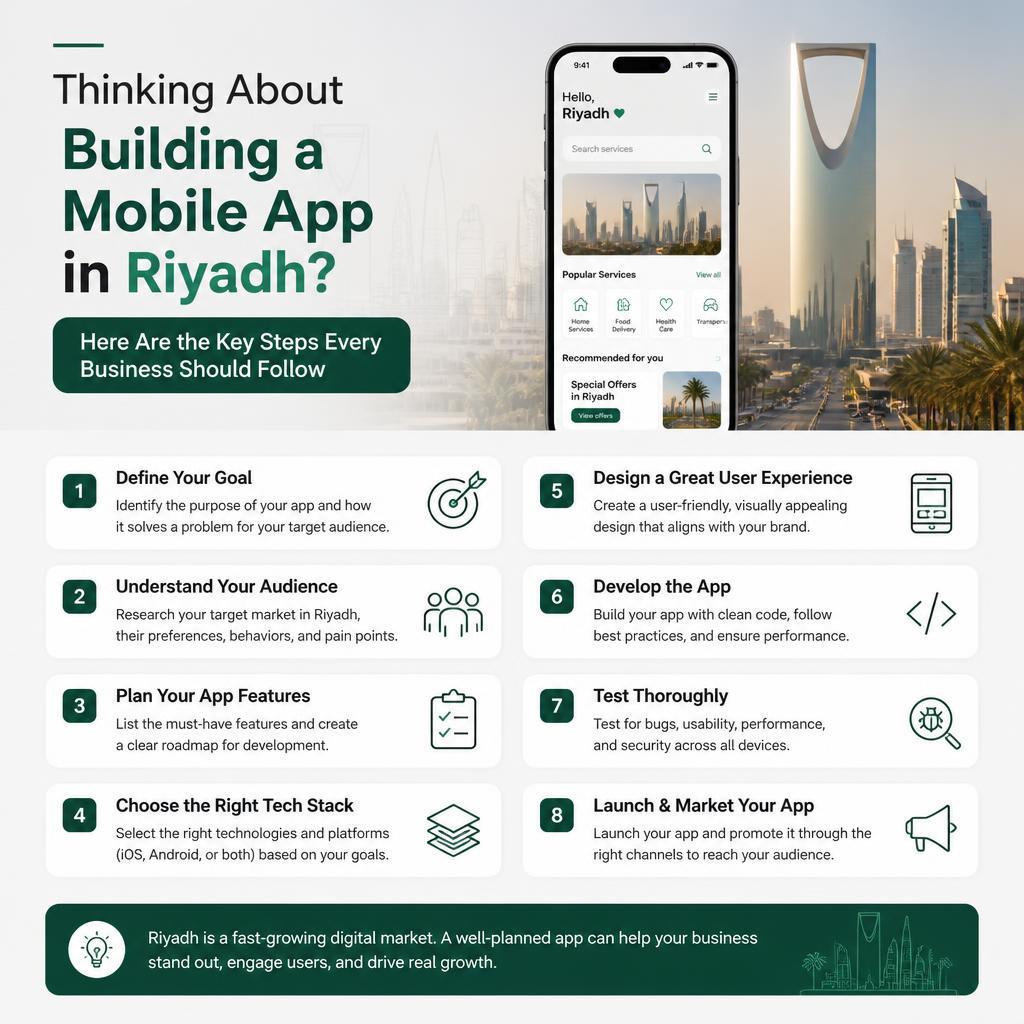
Smartphones have changed the way customers discover brands, compare services, place orders, make payments, and communicate with businesses. For companies operating in Saudi Arabia, this shift creates an opportunity to develop digital experiences that are faster, more convenient, and closely connected to everyday customer needs.
If your business is considering whether to build a mobile app in Riyadh, the development process should begin long before designers create the first screen or developers write the first line of code. A successful application starts with a clear business purpose, a strong understanding of its users, and a realistic plan for growth.
For businesses in Riyadh, the right mobile strategy can support customer engagement, streamline operations, strengthen brand visibility, and create an additional channel for generating revenue. However, the application needs to be planned around genuine value rather than technology alone.
Why Should Businesses Build a Mobile App in Riyadh?
A mobile application can give customers a direct and convenient way to interact with a business. Instead of depending entirely on websites, phone calls, physical locations, or third-party platforms, companies can create a dedicated digital environment for their audience.
Depending on the industry, an application can support:
- Online product purchasing
- Service bookings and appointments
- Digital payments
- Delivery and order tracking
- Customer support
- Loyalty and rewards programs
- Personalized recommendations
- Push notifications
- Location-based services
- Business account management
For companies targeting customers in Riyadh, these capabilities can be combined according to specific market requirements.
The important point is that an app should solve a recognizable problem. Simply launching an application does not guarantee customer adoption. People are more likely to return when the platform saves time, simplifies a task, provides useful information, or offers an experience that traditional channels cannot provide as effectively.
1. Define the Business Purpose Before Development
The first step in mobile app development in Riyadh is defining what the application is supposed to achieve.
Different organizations may have completely different reasons for investing in mobile technology. A retailer could want to increase online sales, while a restaurant may focus on ordering and delivery. A logistics company might need real-time tracking, whereas a professional service provider could prioritize appointment scheduling.
Before development begins, establish answers to questions such as:
- What business problem will the application address?
- Who are the primary users?
- What action should users complete?
- Which existing process needs improvement?
- What result would make the project successful?
Clear objectives provide direction for design, technology selection, budgeting, and future marketing.
A focused objective is generally more useful than a long list of unrelated features.
2. Research Your Customers in Riyadh
A good application should reflect the people who will actually use it.
Before you build a mobile app in Riyadh, research your target customers and understand their expectations. Look at how they currently discover businesses, what difficulties they encounter, what influences purchasing decisions, and where existing digital services fall short.
Businesses can gather useful insights through:
- Customer interviews
- Online surveys
- Competitor research
- Existing website analytics
- Customer support conversations
- Reviews and feedback
- Market research
- Testing early product concepts
Local understanding matters because the requirements of customers in Riyadh may differ from those of audiences in other markets.
This research can influence everything from navigation and content to payment options and communication methods.
3. Decide Which Features Are Essential
Feature planning is one of the areas where businesses can easily lose focus.
It may be tempting to include every feature offered by competing applications. However, excessive functionality can increase development time, raise costs, and make the customer journey unnecessarily complicated.
Instead, separate features into three categories:
Essential Features
These are required for the application to perform its primary purpose.
Valuable Enhancements
These improve usability or engagement but may not be necessary for the first release.
Future Features
These can be introduced after customer behavior provides evidence that they are worthwhile.
For example, an e-commerce application might initially require product discovery, accounts, checkout, payment processing, and order tracking. Advanced recommendation systems or complex loyalty functionality could be introduced later.
This phased approach makes custom mobile app development in Riyadh more manageable while leaving room for expansion.
4. Plan the User Experience Before the Interface
A visually impressive application can still fail if users cannot figure out how to use it.
User experience should therefore come before decorative design decisions. Map the journey a customer is expected to follow from the moment the app opens until the intended task is completed.
Think about:
- How quickly can a new user understand the app?
- Are important actions easy to locate?
- Can customers complete common tasks with minimal steps?
- Are forms simple enough?
- Is information presented clearly?
- What happens when something goes wrong?
For a mobile application in Riyadh, businesses should also consider appropriate language presentation, accessibility, content clarity, and local customer expectations.
The objective should be an experience that feels natural rather than complicated.
5. Choose the Appropriate Technology
There is no single technology stack that is perfect for every application.
Businesses may choose between native development and cross-platform approaches depending on the project. Other decisions can involve databases, cloud infrastructure, APIs, payment gateways, analytics platforms, notification services, and third-party integrations.
The right selection should consider:
- Application complexity
- Expected number of users
- Performance requirements
- Development budget
- Maintenance requirements
- Security needs
- Future expansion
- Integration requirements
An experienced mobile app development company in Riyadh can assess these factors and recommend a technical direction based on the actual business model.
Technology should serve the product—not become the product strategy itself.
6. Prioritize Security From the Beginning
Mobile applications frequently handle valuable customer and business information. Depending on the industry, this may include account details, addresses, transaction information, booking records, or other sensitive data.
Security should therefore be included throughout mobile app development in Riyadh, rather than added as an afterthought.
A development plan may include:
- Secure authentication
- Access management
- Encrypted communication
- Safe data storage
- Vulnerability testing
- Secure API practices
- Regular software updates
- Monitoring and maintenance
Strong security can also support customer confidence. People are more comfortable using digital services when they believe their information is being handled responsibly.
7. Make the Application Fast and Reliable
Performance directly affects the customer experience.
Slow screens, unexpected crashes, failed transactions, and confusing error messages can cause users to abandon an application even when the underlying service is valuable.
Businesses in Riyadh should ensure their applications are tested across suitable devices, screen sizes, operating systems, and realistic network conditions.
Performance testing should examine important customer journeys rather than simply checking whether individual screens function correctly.
After launch, monitoring should continue so technical issues can be identified and addressed before they become widespread.
8. Connect the App With Existing Business Systems
A customer-facing application often needs to communicate with systems already used by the company.
For example:
- Retail apps may connect with inventory platforms.
- Delivery apps may require logistics and tracking integrations.
- Service platforms may connect with appointment systems.
- Financial applications may require secure payment infrastructure.
- Enterprise apps may communicate with internal databases and business software.
Well-planned mobile app development services in Riyadh can connect these systems to create a more complete digital workflow.
This can benefit customers while also reducing repetitive manual work for employees.
9. Test the Product With Real Users
Internal testing is important, but real users can reveal problems that development teams may overlook.
Before a major launch, businesses can invite a small group of representative customers to test the application.
Ask them to complete realistic tasks and observe where they hesitate, make mistakes, or become confused.
Useful feedback can uncover issues involving:
- Navigation
- Registration
- Checkout
- Search
- Content
- Notifications
- Forms
- Performance
- Overall usability
The goal is not simply to ask whether users “like” the application. It is to discover whether they can successfully accomplish what the business intended.
10. Launch With a Clear Marketing Strategy
Even an excellent application needs visibility.
Businesses should plan how customers will discover the app before launch. Existing website traffic, social media audiences, email lists, physical locations, advertising campaigns, and customer communications can all contribute to awareness.
For a business serving Riyadh, promotional messaging should explain the practical benefit of downloading the application.
Instead of saying only “Download our app,” communicate the value—for example, faster ordering, easier reservations, exclusive offers, simpler account management, or convenient tracking.
A clear reason to install is often more persuasive than a generic promotional message.
11. Monitor What Happens After Launch
The first version of an application should be viewed as the beginning of an ongoing process.
Businesses can monitor indicators such as:
- Downloads
- Registrations
- Active users
- Retention
- Conversion rates
- Feature engagement
- Abandoned transactions
- Customer reviews
- Support requests
These insights help determine what should be improved next.
For companies operating in Riyadh, customer behavior can provide valuable information about which services are most useful and where the digital experience can become more efficient.
Continuous improvement also allows the application to evolve as customer expectations change.
12. Select the Right Development Partner
Choosing a development partner can have a major impact on the final product.
Businesses should examine more than the quoted price. Consider the team's experience, technical capabilities, communication process, design expertise, testing approach, security practices, maintenance services, and ability to understand business objectives.
A capable partner should be willing to discuss the problem before recommending a solution.
Five Programmers can assist businesses with mobile application planning and development while keeping the product aligned with specific operational and customer requirements.
The development relationship should ideally continue beyond coding, covering testing, deployment, maintenance, improvements, and future functionality.
Common Mistakes Businesses Should Avoid
Before beginning mobile app development in Riyadh, watch for these common mistakes:
Building Without a Clear Purpose
An application without a defined business objective can quickly become expensive without producing meaningful results.
Copying Competitors
Competitor research is useful, but copying another company's feature set does not guarantee that it will suit your customers.
Ignoring User Feedback
Customer behavior often reveals opportunities that were not visible during initial planning.
Adding Too Many Features
More functionality does not automatically create more value. Simplicity can be a major advantage.
Treating Launch as the Finish Line
Applications require updates, monitoring, security maintenance, and ongoing optimization.
How Much Planning Is Needed Before Building an App?
The amount of preparation depends on the complexity of the project. A simple customer-facing application may require a relatively focused discovery phase, while an enterprise platform involving several integrations may need extensive planning.
At minimum, businesses should establish:
- Target audience
- Core business objective
- Primary user journeys
- Essential features
- Technology direction
- Security requirements
- Development budget
- Expected timeline
- Testing strategy
- Post-launch improvement plan
Having these elements defined can make the development process more predictable.
Frequently Asked Questions
What types of businesses can benefit from a mobile app in Riyadh?
Retailers, restaurants, logistics providers, healthcare organizations, education companies, service businesses, marketplaces, hospitality brands, and many other organizations can use mobile applications when the technology solves a meaningful customer or operational need.
Should a business launch all planned features at once?
Not necessarily. Starting with essential functionality can allow the business to validate the concept, collect feedback, and prioritize later improvements based on actual user behavior.
Why is local market research important for an app targeting Riyadh?
Local research helps businesses understand the expectations, habits, preferences, and service requirements of their intended audience. This can lead to a more relevant and useful digital experience.
What should businesses look for in an app development company?
Look for technical expertise, relevant project experience, transparent communication, strong testing practices, security awareness, post-launch support, and a willingness to understand the business problem before proposing technology.
Final Thoughts
Deciding to build a mobile app in Riyadh is an important business investment, but successful results depend on much more than development alone. The strongest applications begin with customer research, a defined purpose, carefully selected functionality, thoughtful UX, secure technology, rigorous testing, and continuous improvement.
For businesses targeting Riyadh, local customer expectations should remain central throughout the process. A useful application can make services easier to access, strengthen customer relationships, improve internal efficiency, and create new opportunities for digital growth.
The best time to start is not when every feature has been imagined. It is when the business has clearly identified a problem worth solving and is ready to create a practical digital solution around it.
Five Programmers can help transform your mobile application idea into a structured, customer-focused digital product designed for your business objectives.
Ready to Build Your Mobile App?
Have an application idea for your business in Riyadh? Start with a clear strategy, define your priorities, and work with a development team that understands both technology and business goals.
Contact Us today or Get a Free Quote Today and take the first step toward creating a mobile application built around your customers and your growth plans.

 English
 Arabic
 French
 Spanish
 Portuguese
 Deutsch
 Dutch
Dutch
 Italiano
 Russian
 Romaian
 Portuguese (Brazil)
 Greek
Greek