
Understanding Timing Belts, Fan Belts, and Pulley Systems

Belt-driven systems are at the core of many mechanical and industrial applications. From manufacturing equipment to power transmission systems, belts and pulleys play a critical role in controlling motion, speed, and torque. However, not all belts function the same way, and selecting the wrong type can lead to inefficiency, wear, or system failure.
This article explains timing belts, fan belts, rubber V belts, and pulley systems, how they work together, and how to choose the right combination for reliable performance.
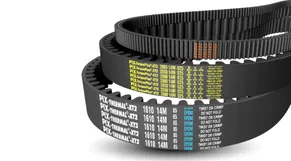
What Is a Timing Belt?
A timing belt is a synchronous belt designed to transmit power with precise timing and no slippage. It features molded teeth that engage directly with matching grooves on pulleys.
Timing belts are commonly used where:
- Exact speed ratios are required
- Shaft synchronization is critical
- Slippage cannot be tolerated
How Timing Belts Differ from Rubber V Belts
While both timing belts and rubber V belts transmit power, they operate on different principles.
Timing Belts
- Use toothed engagement with pulleys
- Provide accurate motion control
- Do not rely on friction
- Ideal for precision applications
Rubber V Belts
- Use friction between the belt and pulley
- Allow slight slip under load
- Suitable for general power transmission
- Common in industrial drives and HVAC systems
Understanding Fan Belts and Their Applications
A fan belt is a type of belt used primarily to drive auxiliary components such as fans, pumps, or alternators in mechanical systems.
Fan belts are typically:
- Designed for continuous rotation
- Used in systems where load variation is expected
- Selected for durability rather than precision
The Role of Pulleys in Belt Systems
Belts cannot function effectively without correctly designed pulleys. Pulleys guide the belt, transfer torque, and maintain alignment.
Key pulley functions include:
- Matching belt profile and pitch
- Maintaining correct belt tension
- Ensuring smooth power transmission
- Reducing wear and vibration
How Timing Belts and Pulleys Work Together
In timing belt systems, pulley accuracy is critical. Even minor alignment issues can affect belt life and system performance.
Proper timing belt and pulley integration ensures:
- Accurate speed ratios
- Reduced backlash
- Longer service life
- Lower maintenance requirements
Common Factors That Affect Belt Performance
Regardless of belt type, performance is influenced by several factors:
- Load conditions
- Operating temperature
- Belt tension
- Pulley alignment
- Environmental exposure
Selecting the Right Belt and Pulley System
Choosing the correct belt system starts with understanding the application.
Consider:
- Required torque and speed
- Accuracy requirements
- Operating environment
- Maintenance access
- Expected service life
Why Quality Matters in Belt and Pulley Systems
Low-quality belts or mismatched pulleys often result in:
- Increased downtime
- Excessive wear
- Energy losses
- Unexpected failures
Why Engineers Trust PIX Middle East
PIX Middle East supplies engineered solutions for timing belts, rubber V belts, fan belts, and pulley systems designed for demanding industrial environments.
Their focus on material quality, precision manufacturing, and application-specific design supports consistent performance across industries.
Conclusion
Timing belts, fan belts, rubber V belts, and pulleys each serve a distinct purpose in mechanical systems. Understanding how they differ and how they work together is essential for building efficient, reliable machinery.
Selecting the right belt and pulley system reduces downtime, improves accuracy, and extends equipment life. With proper design and quality components, belt-driven systems remain one of the most effective solutions for power transmission.
Sourec: https://www.pixmiddle-east.com/understanding-timing-belts-fan-belts-pulley-systems.php

 Arabic
 French
 Spanish
 Portuguese
 Deutsch
 Turkish
 Dutch
Dutch
 Italiano
 Russian
 Romaian
 Portuguese (Brazil)
 Greek
Greek